


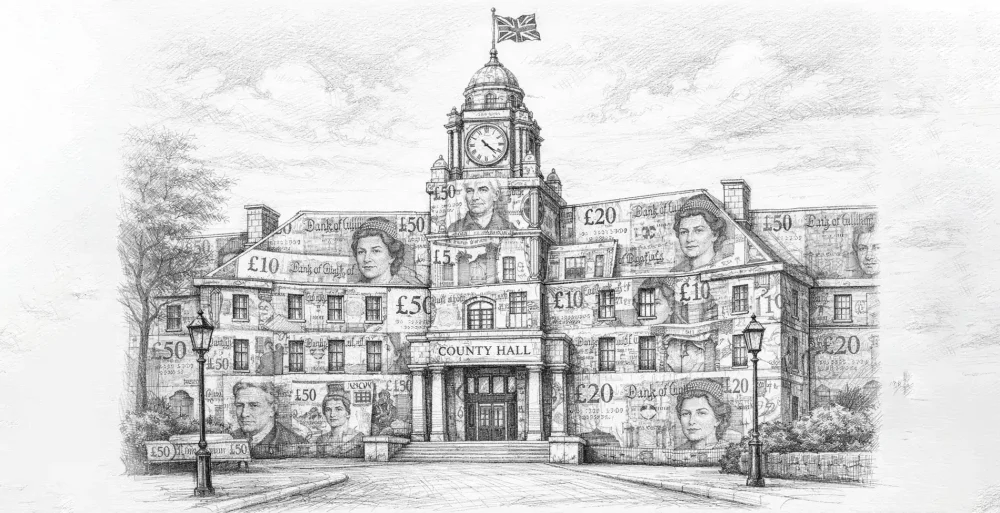
SOMERSET residents are facing another whopping increase in council tax.
It is no secret the county authority – formerly Somerset County Council and from 2023, Somerset Council – is in financial dire straits.
Rising costs of adult and children’s social care, combined with inflation and more, have seen bills paid by our council skyrocket.
That, combined with falling money from central government, has led to the current situation, as we’ve spoken about before.
Now, as eyes turn towards setting Somerset Council’s 2026/27 budget, council tax rises are back on the agenda.
As the authority looks to plug a huge funding shortfall – some £73 million – the Liberal Democrat administration is looking at proposing an increase that would, in total, see bills rise by almost 11%.
There’s no doubt, as households continue to battle a cost-of-living crisis, any increase will not go down well – particularly as it comes hot on the heels of last year’s 7.5% rise.
Opposition members have already slated the idea, with Cllr Diogo Rodrigues (Con, Bridgwater East & Bawdrip) saying the council is treating Somerset families as “a bottomless source of cash to cover poor decision-making”.
He said: “(The administration has) confirmed they have asked Government for permission to raise Council Tax by 5.9% on top of the existing 4.99% limit, an increase of almost 11% in a single year.
“This comes after last year’s 7.5% council tax rise, when the same administration originally sought an increase of more than 20%. Time and again, Somerset residents are being asked to pay the price for this council’s failures.
“While declaring a financial emergency, the Liberal Democrats have spent over £33 million on agency staff while cutting 555 job posts, are splashing £20m on consultants to tell them how to save money, are spending £3m with consultants to tell them how much to pay staff, have lost around £100m through rushed asset sales, and signed off the disastrous Life Factory project in Glastonbury where millions of pounds were handed over without proper checks and balances. It’s Somerset residents that pay the price, including the thousands of disabled households who are now around £400 a year worse off following cuts this council made to their Council Tax Support.
“Somerset families are already under pressure from rising bills and the cost of living, and they are being treated as a bottomless source of cash to cover poor decision-making at Liberal Democrat-run County Hall.”
In response, leader of the council, Cllr Bill Revans (Lib Dem, North Petherton), pointed to the rising costs and the ‘unfair’ council tax system.
“We’ve been saying for some time that council tax is not a fair system for funding essential demand-led services like social care,” he said. “Despite last year’s increase, Somerset residents still pay less council tax than the unitary average, and less than neighbouring councils like Dorset, Cornwall, Devon and Wiltshire, due to historic decisions by legacy councils to freeze council tax in Somerset between 2010 and 2016. This means we have less money to fund essential services.
“Our finances remain fragile and we are in discussions with the Government around further Exceptional Financial Support for this year.
“If the Government were to agree to a 5.9% increase above the 4.99% cap, this would bring Somerset Council in line with the Government’s figure of £2,060 for a Band D property which they use when calculating grant funding.
“No formal requests or firm decisions have been made – any potential increases will be discussed and agreed by councillors as part of budget setting in February.
“We continue to lobby on behalf of Somerset residents and urge Government to accelerate their long-promised plans for reform of council tax to create fairer funding for local government.”
In his comment, Cllr Revans made some points we thought we’d look at. We have touched on them before, but the fresh round of increases means it’s worth another look…
Cllr Revans said “Somerset residents still pay less council tax than the unitary average” – even after the 7.5% increase last year.
Government figures show the average Band D council tax rate set by unitary authorities in England for 2025/26, not including other precepts such as parishes, police and fire, was around £1,913.
In Somerset, according to the council’s own analysis, the council precept alone was £1,593.67, which also includes a £14.65 charge for the Somerset Rivers Authority, which others don’t have, so you could even go a bit lower, to around £1,580. So, Somerset does sit someway below the unitary average. But that doesn’t tell the whole story, of course, because Somerset is – relatively – a pretty poor county.
In April last year, data from the Office for National Statistics showed the median gross weekly wage for full-time employees in the county was £708. For comparison, that rises to £716 in North Somerset, £840 in South Gloucestershire, and £728 in the Wiltshire unitary area.
Comparing the Band D rates with those higher-earning neighbours, we find:
- Somerset: £708, £1,580
- North Somerset: £716, £1,793.75
- South Glos: £840, £1,931.33
- Wiltshire: £728, £1,886.99
- Dorset: £709, £2,101.05
Looking at those numbers, Somerset does indeed pay less than its neighbours. We are poorer, but we do pay less.
Again, that doesn’t necessarily make us feel any better when we’re all struggling to keep the lights on and food on the table, but it is a basic truth we should consider, all things being equal.
Another thing Cllr Revans highlights is a series of “historic decisions by legacy councils to freeze council tax in Somerset between 2010-2016”.
Now, this is somewhat complicated, because as we all know, prior to 2023, there were five councils in the county – Mendip, Sedgemoor, Somerset West and Taunton, and South Somerset districts, as well as Somerset County Council.
Post-2023, we have had a single unitary authority, Somerset Council.
For the purposes of this analysis, we will simply look at Somerset Council as compared to Somerset County Council, as that was the overarching authority.
Cllr Revans is quite right – data shows that from 2010/11, up to and including 2015/16, Somerset County Council did not increase its precept (charge) at all. And councillors made a big song and dance about it too, as you would expect (I can remember the press releases touting the decision).
But whatever the rights or wrongs of those freezes, over those six years, people in Somerset got used to paying a certain amount of council tax, even allowing for some increases from parish and district councils, but more on that in a bit.
Now, after a pandemic, a war in Ukraine, a surge in social care costs and rising inflation, that amount is simply not enough. So things have had to increase. And it feels like a lot.
Cllr Revans argues this would not have been quite so drastic had the county council increased council tax – even by a bit – in those six years. And he has a point. It is also worth considering the impact of creating a unitary authority in 2023.
For example, during the six years of zero increases from the county council, the districts were able to increase their precepts (their share of the council tax bill). And some did, regularly. Sedgemoor District Council, for example, increased its share of the council tax by 3.4% in 2013/14, while South Somerset District Council increased its share by 2% in 2010/11.
The thing is, these increases were relatively small, when compared to the amount charged by the larger county council. So when everything comes together – as it did in 2023 – Somerset Council has to increase to cover every area, including its own, and people feel that a lot more.
So who was to blame? Well, Cllr Revans clearly wants us to infer previous Conservative administrations at Somerset County Council. So let’s check that.
The Liberal Democrats controlled Somerset County Council after elections in 2005. However, they lost control to the Conservatives in 2009, who retained control until 2022, when the Liberal Democrats won by a landslide in the last election of Somerset County Councillors.
Cllr Revans is correct in what he says – the Conservative administrations at Somerset County Council made the decision not to increase its share of the council tax from 2010/11 until 2015/16.
They did increase council tax by 5.3% in 2016/17, by 6% in 2018/19, and 4% in 2020/21, for example, when then-leader – Cllr David Fothergill – was himself decrying the local authority funding system.
In 2019, Cllr Fothergill said the authority had been battling to avoid bankruptcy amid government spending cuts and the rising demand of social care – exactly the same things being said by Cllr Revans now.
Cllr Fothergill was among dozens of council leaders who, in 2019, signed a letter calling on the Conservative Government to commit to “fair funding for our underfunded and overburdened councils”.
Sound familiar?
Cllr Revans says this has not happened to anything like the required degree to help authorities like Somerset make ends meet.
Again in 2019, Cllr Fothergill said the rising costs of social care were a “time bomb” that was “ticking and it’s getting louder”.
In recent years it seems, that bomb has gone off.
And it’s not just here. Looking further afield, councils across the country are facing exactly the same pressures.
For example, Reform UK took over the running of Derbyshire County Council at last year’s local elections – but despite the party’s pre-election claims of millions being available in savings, the administration is proposing a 5% increase in council tax for 2026/27 to plug a £38m funding gap. And Reform-led Staffordshire County Council is proposing a 3.99% increase in council tax, with the Conservative opposition leader saying the increase was a repudiation of Reform’s claims of “wasteful spending”, and that “they have found no waste and this budget is largely a roll-over of the previous plans set by the Conservatives”.
And Reform councillor for efficiency in Derbyshire, Cllr John Lawson, said something which might sound familiar: “The pressures in some areas, especially in children’s social care, are incredibly challenging, but careful planning across the council as a whole means we are looking to the future with confidence.”
Right next door, in North Somerset, the exact same problems have occurred. Leader Mike Bell has written to the Prime Minister calling for changes to the funding formula, as our near neighbours claim they will lose around £18m under the new calculations.
Again, adult and children’s social care are at the forefront of the funding crisis, along with ‘low’ council tax rates – which will now need to be increased.
So, whatever your political persuasion, some things remain clear – the “time bomb” the Conservatives warned about has gone off, in the hands of a Liberal Democrat administration in Somerset, with similar explosions felt at Reform-, Lib Dem- and Conservative-led councils elsewhere.
Being unable to balance the books is not party political, it would seem, no matter what any politician wants you to think.
Sure, we can agree over how money is spent here and there – more on potholes, less on leisure centres, that sort of thing, but the basic fact remains – councils in England, of all colours and none, are struggling to balance their books.
But that doesn’t help us, the resident, as we are asked to do more and more.
We – and our councils – need help from somewhere, and that can and should come from the top. But that is for another time…
PAUL JONES
Editor in Chief
READ MORE: OPINION: ‘Bailoutistan’ – why are Somerset’s finances in such a mess?
READ MORE: Council tax rises on the agenda as Somerset receives details of financial settlement





This article is not quite correct. In comparing council tax figures it quotes Somerset Council’s Band D charge as £1,580. But this excludes the social care precept of £263.94 which Somerset Council charges in addition, so the correct Band D figure should be £1,857.61. The figures used in the article for North Somerset, South Gloucestershire, Wiltshire and Dorset do include the social care precept so the comparison table is not completely accurate.
Very good factual information but it does not consider zero merger planning for 3.5 years. Implementing a redundancy programme before a still absent so called ‘transformation plan’ has created a real mess.
We do not know why the council did not plan what is really the perfectly normal business merger achieved by Wiltshire 15 years ago. Was it because the Liberal Democrat leadership are still ideologically opposed to one unitary council or perhaps this was the way the new highly paid chief executive proposed and the leadership were not prepared to reject this?
Grant Thornton issued Statutory Recommendations 1 and 2 in January 25 to develop detailed savings plans at pace and detailed transformation business cases at pace
One year later the council is paying Newton Consulting up to £20m for advice to ‘Improve services, enhance workforce experience and thirdly achieve long term financial sustainability’
One month before these detailed plans are needed all they have come up with is ‘a whole council diagnostic (much bigger than failed Southwest One) to set up a programme for success by providing an evidence base of opportunities that improve outcomes and experience. The diagnostic output will inform the planning of the programme and provide insight to allow for the prioritisation and sequencing of the initiative to have the greatest short term impact’.
This seems to be the complete opposite of ‘at pace’
Hi Paul,
Good article. Fair points. Two years of council tax freezes at the height of austerity (triggered by the reckless investment banks and not councils) was justified. Thereafter, the base budget was eroded by inflation.
In the inevitable “blame game”, let’s not forget the original sin of the coalition government (of Tories and Lib Dems) who between 2010-15 cut council funding by 28% in real terms.
However, there is no mention in your article of the Red Card statutory recommendations by the Auditor’s Grant Thornton.
With regard to efficiency savings (“transformation”) Somerset Council had two and, this year, they were re-issued. I know of no other Council that has achieved this dubious accolade of 4 Red Cards (plus a new one for the oversight failures at The Life Factory).
Just before Christmas, the internal auditors pointed out a number of basic issues with financial management and controls. Amidst a self-declared “financial emergency”, financial management and controls should be fully compliant and there should be zero tolerance for purchasing without compliance.
Regrettably, our new unitary council did not get off to a good start and opportunities to plan restructuring and drive efficiency savings from 5 councils into 1, have been squandered and now look to be 2 years behind where they should be.
Whilst the social care issues are national, they shouldn’t be used to divert attention from local financial failings, poor local leadership and financial management.
Somerset’s unnecessary costs are from a failure to merge five councils into one for 3.5 years.
Grant Thornton has just reissued statutory recommendations 1 & 2 calling for detailed savings at pace and detailed transformation at pace.
The first thing the Council must do is cut all non-statutory services. Tax is mandatory so it should only cover services required by law.
Once those services have been cut then review the budget, and look at what taxation is necessary to cover it.