


IN June 2012, headlines screamed of George Osborne’s “biggest U-turn yet”.
The newspaper sensationalism was in response to a reversal of the then-Chancellor’s decision to increase fuel duty – the tax paid at the pump by drivers filling up – by 3p.
Sensible, you may say, when households were struggling with the aftermath of a global financial crisis which brought the international banking system to the brink of collapse.
But since then, the standard rate of fuel duty on petrol and diesel has been frozen.
Again, as we face a fresh cost-of-living crisis, war in Ukraine and more, this may appear welcome.
However, the truth of the matter is, fuel duty is a big, big part of HMRC’s budget. It brings in a lot of money to pay for services such as the NHS.
In the financial year 1999/00, revenues from fuel duty made up 2.1% of the UK’s gross domestic product (GDP).
GDP, for the non-economically minded among us, is the main measure of economic growth, based on the value of goods and services produced.
But regardless of it’s technical definition, it is a vital tool showing the health of the economy; a growing GDP is a growing economy.
It’s no secret, due to numerous factors, the UK economy has not been in the best of places in recent times, stretching back to the global financial crisis.
Indeed, more recently, the UK entered a recession at the end of 2023, after negative GDP growth in the last two quarters of the year.
But why does fuel duty matter?
Well, let’s take another trip down memory lane…
It is 1993, and the Conservative Government, led by John Major, introduced the fuel price escalator – a rather grandiose name for a formula that would control fuel duty rises in the coming years.
That year, 72.8% of the prices people paid for their petrol was made up of tax (for every £1 you spent at the pump, 72.8p went to the Treasury).
The fuel price escalator was designed to take the political sting out of increasing that rate, by laying out changes in advance.
When it was introduced, the government of the time dictated the escalator would gradually increase the rise in fuel duty above the rate of inflation – starting at 3% above, which rose to 5% above in the following years.
When Tony Blair’s Labour was elected in 1997, they increased the final rate rise to 6%.
So, fuel duty was always rising, year-on-year, bringing more money in to the Treasury.
Jump forward to the year 2000 and Tony Blair’s first-term saw one of its biggest crises.
Lorry owner-operators in the south east decided enough was enough – fuel prices had got too high.
By that point, for every £1 spent at the pump, 81.5p was now tax, for unleaded petrol. Too much for the hauliers to bear.
Independent haulage firms blockaded oil refineries, prompting panic buying at petrol pumps across the country, and a huge headache for the government, which argued rises in the price of oil – and not higher taxes – had caused the spiralling costs of petrol.
But people were not happy.
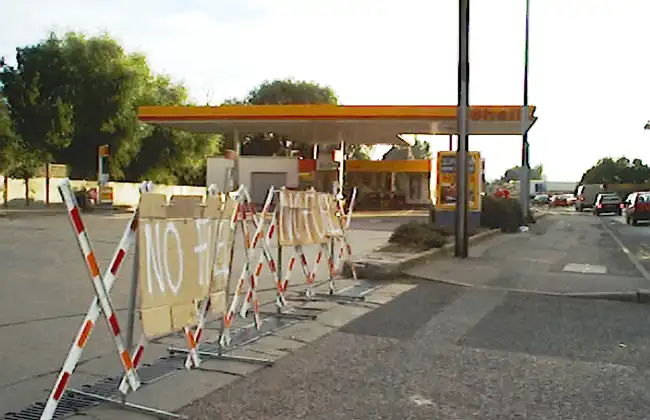
Fuel protests in 2000 saw panic buying across the UK. Picture: Hywel Williams/geograph.org.uk
In November 2000, to stave off protests and bad feeling among motorists, then-Chancellor Gordon Brown announced fuel duty would be frozen until at least April 2002. The fuel escalator was, effectively, binned.
Other taxes on fuels were also lowered, including for most lorries, easing tensions with hauliers.
As well effectively ending the fuel duty escalator, politically, it also ended the chance of raising fuel duty without all hell breaking loose.
But when the Coalition Government led by David Cameron came to power in 2010, Chancellor George Osborne decided it was time for an increase – and was set to raise it by 3p, returning to the previous starting point of the fuel duty escalator – before his “biggest U-turn yet”, amid fierce criticism of the rise from not only the Labour opposition, but his own backbenchers.
Then, in the 2011 Budget, Mr Osborne performed a full about-turn – a 1p cut in fuel duty – with Labour’s increase tool axed for the rest of the parliament.
He referred to the decision in a recent podcast talking about the impact fuel duty freezes have had.
Mr Osborne said: “When I became chancellor in 2010, I tried to get off the essentially stuck position that Labour had been in since the fuel tanker dispute back in around 2000 (the petrol dispute).
“After that, the Blair/Brown governments never raised fuel duty.
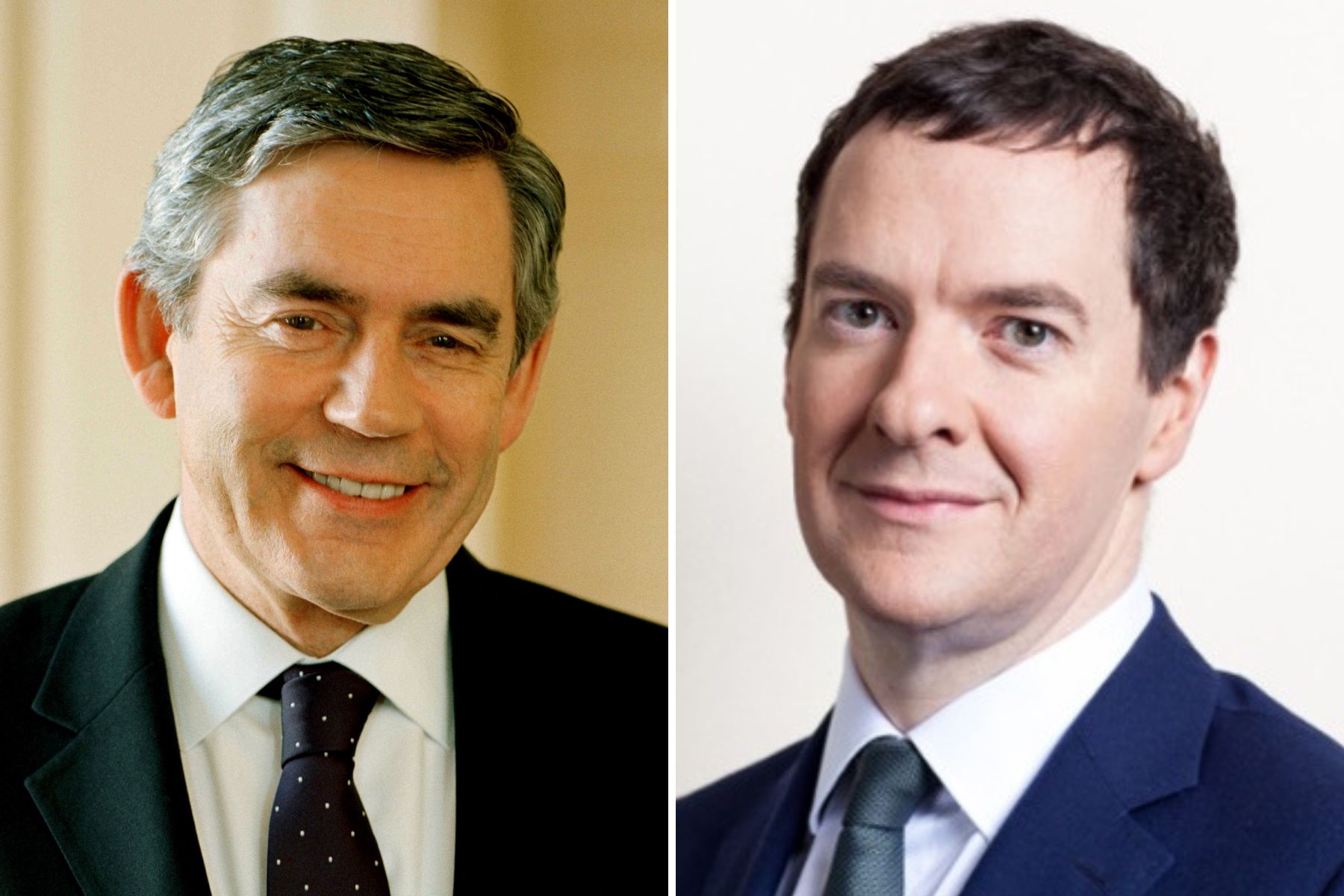
Gordon Brown, left, and George Osborne both had issues with fuel duty…
“So I come in and I think, ‘that’s ridiculous we cant raise fuel duty, as it goes up with inflation’ and I proposed an increase.
“And then the shadow chancellor teams up with Tory backbenchers and basically defeats me. And as a result I have to freeze fuel duty, indeed cut fuel duty initially.
“After that, no Tory chancellor has ever dared raise fuel duty either, and the result is material.”
So, since 2011/12, fuel duty has been frozen.
Governments are, understandably, frightened of motorists, terrified of being blamed for raising taxes on something so fundamental to our lives as our cars – and the price of petrol.
The current Conservative Government, elected in 2019, has continued to freeze fuel duty, which they claim has saved motorists “a cumulative £1,000 by April 2020, compared with what they would have paid under the pre-2010 fuel duty escalator”.
And Chancellor Jeremy Hunt (Con, South West Surrey) continued that tradition in his Budget on March 7.
All well and good, you may say, one less thing we have to worry about.
But – and it’s a big ‘but’ – this does not come without consequences.
Going back to the UK’s GDP – that vital indicator of economic health…
A government report, published in April 2014, showed the steadily rising income from fuel duty up to the year 2000 – those protests – and the declining trend since.
In 1999/00, when those receipts hit their peak, the Office for Budgetary Responsibility (OBR) says fuel duty made up 2.1% of the UK GDP (£22.5 billion).
Another graph, from the OBR, shows how that percentage has fallen ever since.
In 2022/23, fuel duty made up just 1% of UK GDP (£24.8bn), predicted to drop to 0.9% by 2027/28 (£25.9bn).
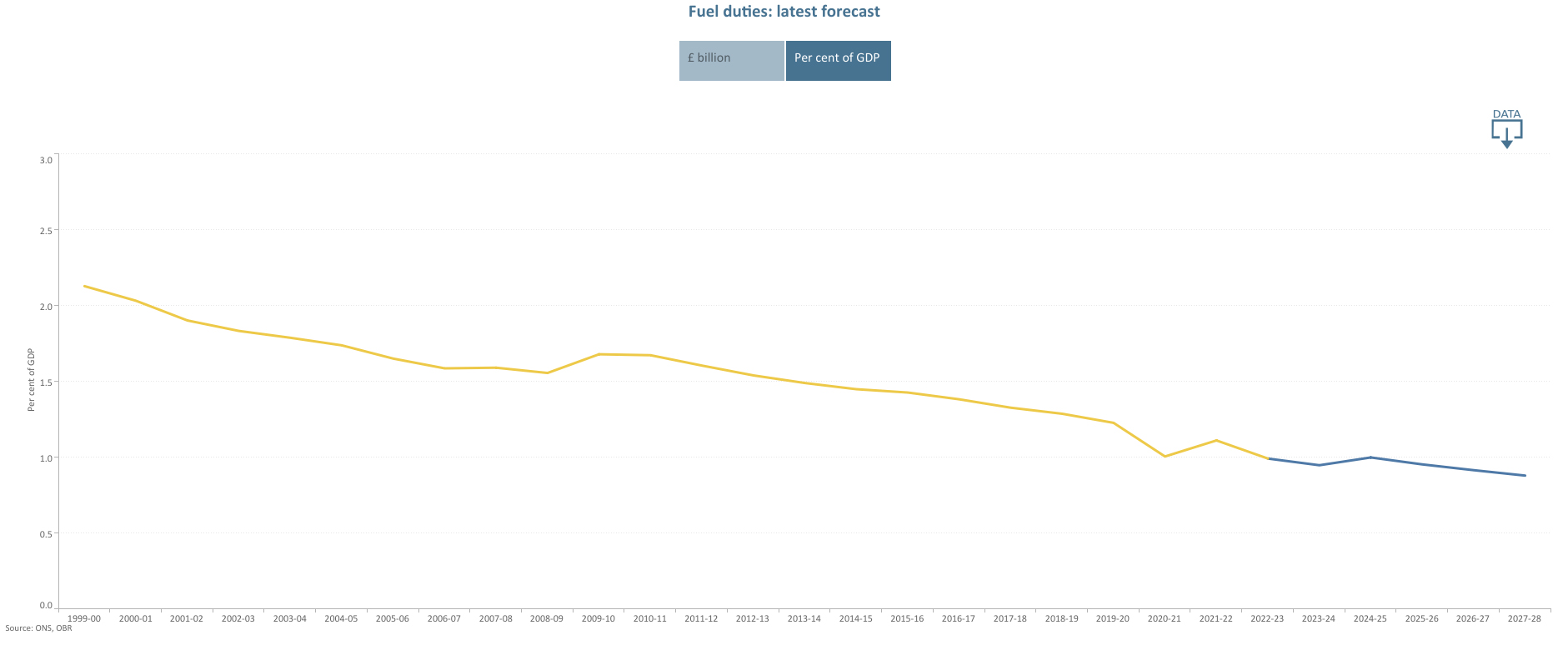
The OBR figures and forecast for fuel duty as a percentage of GDP in the UK. Picture: OBR
These may sound like small numbers, but until 2000, fuel duty had been an increasing amount of money for decades, growing the UK economy.
Since then, it has not. While the amount may have risen, in real terms, and as a share of GDP, it has fallen relatively dramatically.
“In cash terms, both receipts and GDP will tend to rise over time because of economic growth and inflation,” the OBR explained. “Receipts as a share of GDP is the most relevant metric when considering the sustainability of the public finances.”
When “considering the sustainability of public finances”, fuel duty has run out of gas.
And there is another little sting in the tail of this saga.
MORE ANALYSIS: How Somerset politicians are shaping what you see on Facebook – and why…
Though fuel duty increases have been frozen since 2011/12, every government since then has said it intends to increase them – before deciding not to, thus avoiding political fallout and having a ‘nice’ thing to announce, ‘saving’ households.
However, when a government is intending to increase income, such as through fuel duty, the extra money this would bring in features in future calculations.
So, the OBR – which publishes long-term economic forecasts on which governments can make policy decisions – assumes extra money is coming.
When it says the government has this amount of money to play with, it includes extra cash from the fuel duty increase which, for the last 13 years, has later been whipped away by the Treasury.
This means many, many conversations on the UK economy going forward are based on, essentially, inaccurate figures.
This is handy when you are outlining spending – ‘we have this much money to play with’ – but not when reality bites and that money is not actually there.
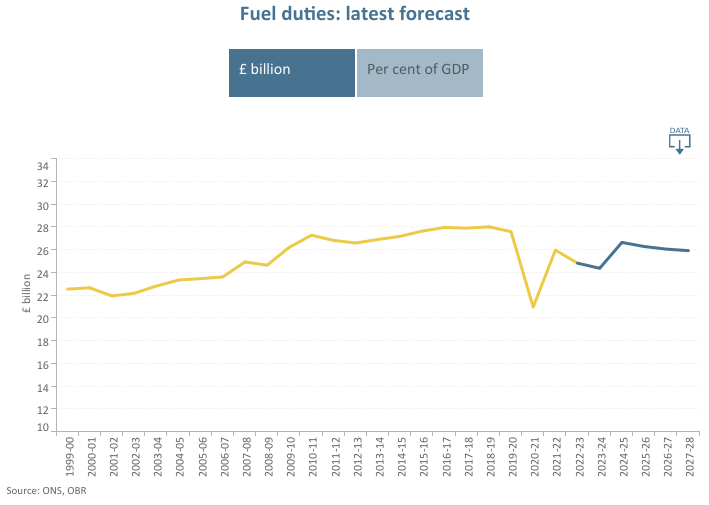
The OBR figures and forecast of fuel duty revenues
So, while we all welcome cuts to the cost of filling up, it can be argued we are paying in myriad other ways, as falling income for the government is falling income for public services and in the ability to cut other taxes, or increase benefits.
It is a point former chancellor Mr Osborne agrees with, as mentioned on the podcast.
“Yes, of course you can say it’s helped motorists, but it’s led to a serious shortfall in tax revenues from this source,” he added.
“We are now around £60bn short of money we otherwise would have had, had the fuel duty escalator continued to rise, according to the Institute for Fiscal Studies. And that, today, would mean around £14bn, £15bn extra money in the budget this year. And when we talk about all the pressures on public services or indeed all the things you’d like to do to cut other taxes, that would be very useful money to have.”
And going by their own figures, politics at the pumps has cost the Treasury – and us – dear.







Leave a Reply