


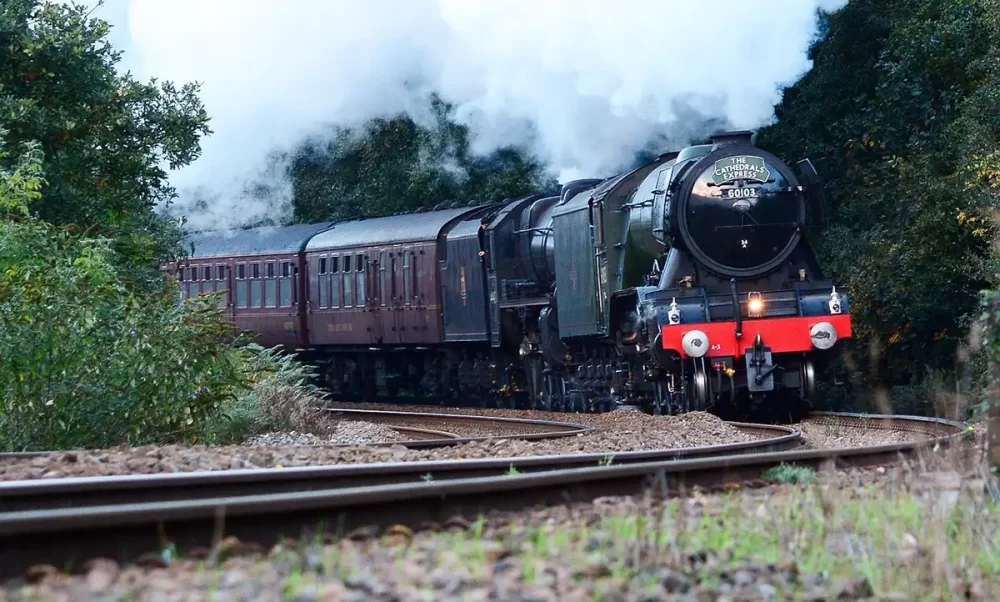
LATER this month, the famous Flying Scotsman will visit Somerset, bringing rail lovers out in force to get a glimpse of the world-famous locomotive.
However, the arrival has seen a decades-old controversy re-emerge.
Now, the West Somerset Railway has detailed the debate over whether the Flying Scotsman’s famous 100mph record had actually already been achieved – right here in Somerset.
In November 1934, the Flying Scotsman headed a special test train on the East Coast mainline and became the first British steam locomotive to be officially timed as travelling at 100 miles per hour, courtesy of the scientific instruments in a dynamometer car.
However, a question remains. Was the three figure speed reached near Wellington and Taunton some 30 years before?
READ MORE: Flying Scotsman set to steam in Somerset this summer
In the first decade of the 20th century, transatlantic liners docked at Plymouth and passengers and mails were then taken to London by train.
An arrangement existed whereby the passengers travelled on the London and South Western Railway via Salisbury to Waterloo and the mails plus valuable metals such as gold headed for Paddington on the Great Western.
Apart from an engine change, at Templecombe or Bristol respectively, the trains ran non-stop on special timings.
The LSWR and GWR had been competing for traffic for more than 60 years and this culminated in a strange, and to modern eyes pointless, competition to take this Ocean Liner trade to London at maximum speed.
And so on a day in 1904, City of Truro coupled onto the mail coaches at Plymouth and set off for the capital.
The line between Castle Cary and Taunton didn’t open until 1906 and so number 3440 was on the Great Way Round route, via Bristol.
There had been fast runs before but it became clear early on that this was full-tilt racing. Some of the speeds on the curves between Plymouth and Newton Abbot were hair-raisingly fast and after Exeter, City of Truro stormed up the climb to Whiteball Tunnel. On the descent from the tunnel it was timed at 102.3mph.
However this figure, which wasn’t published for another quarter of a century, has remained controversial ever since it saw the light of day.
The claimed speed was based on timings made by a journalist, Charles Rous-Martin – who was travelling in the train.
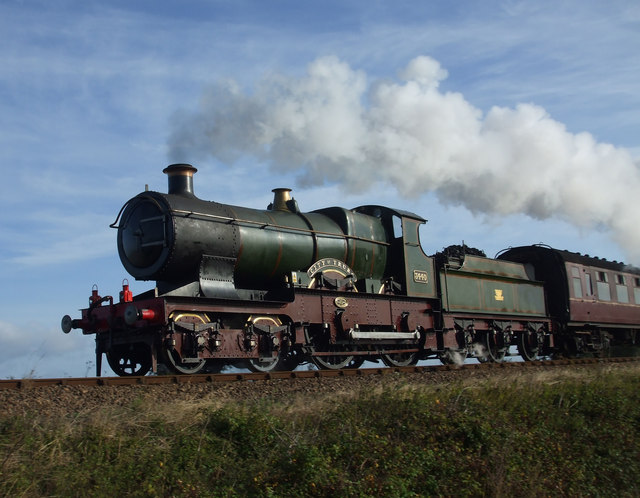
The City of Truro may have hit 100mpg in Somerset – before the Flying Scotsman… Picture: Ashley Dace/Commons
Rous-Martin was a New Zealander who had specialised in railway matters after he moved to Britain. He did his timings using two stop watches and sighting the quarter mile indicator posts as he passed them, stopping and restarting the watches alternatively at each post as well as noting down the times.
He had a long held ambition to reach the magic 100mph figure and he wasn’t averse to exaggeration in his articles. On this occasion he was travelling in a mail coach with less visibility than that from a passenger carriage.
As a result, from the time the details of the run were published and other railway writers began to analyse them, arguments have gone on in print about what speed City of Truro reached that day.
For Great Western fundamentalists, there is no doubt the 100 was attained and for others the figure is in the high 90s.
Overall though, it was a very fast run for the Edwardian era and probably the fastest on any line thereafter for a generation.
Fortunately, the details of its record breaking day, no matter how controversial, were published before City of Truro came out of service and it has been saved for future generations to see and enjoy.
It has visited the West Somerset Railway twice in the past although it is currently out of service as part of the National Railway Museum collection. Meanwhile, the Flying Scotsman will shortly be gracing the Quantock Hills and West Somerset coast.
Back in time once again, the ‘racing’ between Plymouth and London ended in tragedy when, in 1906, a London and South Western Railway Ocean Special passed through Salisbury at high speed and suffered a derailment and collision on the curves at the eastern end of the station.
Several passengers and the loco crew were killed and others injured. Racing stopped promptly but too late.
For more details of the Flying Scotsman visit, log on to west-somerset-railway.co.uk/events/flying-scotsman-events-and-tickets, or call 01643 704996.






Leave a Reply