


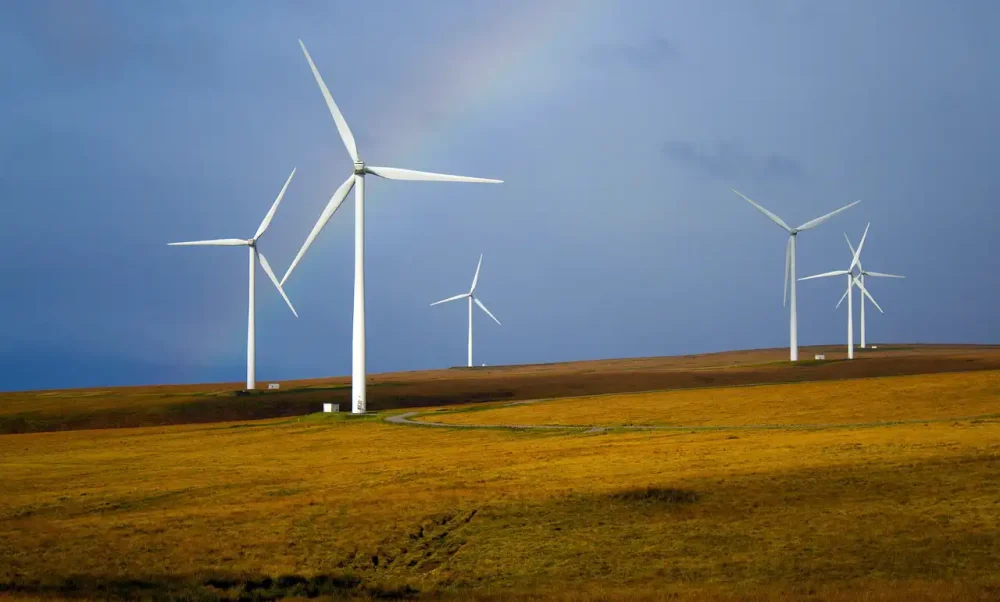
“PEOPLE may not realise it, but their bills would be higher today without the increasing role that wind and solar farms running on free sunshine and wind are playing by reducing our dependence on gas power.”
A while back, I wrote about climate change – a topic I am hugely interested in, but reluctant to put pen to paper about.
Why? Because, if I’m honest, the response to such stories is 90% people shouting at me – and no one likes to be shouted at, do they?
I’m not one to shy away from presenting facts, regardless of the reaction, but most people – instinctively – want to dislike climate change. I presume because it might mean they have to consider their own impact on the planet they, their children and grandchildren, live on – and we fear change. Of course we do, that’s perfectly natural.
So I tend to avoid it.
However…
I recently came across an update on something we discussed in that previous piece – which you can read here.
In that piece, I explained how, far from being the cause of higher energy bills, renewable energy was actually the only real way of bringing down household costs – despite what numerous national newspapers, campaign groups and politicians want you to believe.
Part of the reason fossil fuels drive up bills is that they are the most expensive to produce. As I explained then, the energy ‘wholesale’ market is governed by something called the marginal cost pricing system.
It basically means that when our suppliers buy the energy they need to sell to us, the price they pay for it (and pass on to us through our bills) is set by the most expensive unit of energy sold on the wholesale market.
READ MORE: Environment news from your Somerset Leveller
READ MORE: OPINION: Climate change, denial, scepticism, hysteria – and a 70-year-old warning…
The most expensive is gas, a fossil fuel. So, we pay that amount, even if we are using energy generated renewably. See?
So, in reality, the cost of your energy has absolutely nothing to do with renewable energy – it is dictated by the cost of hugely expensive fossil fuels.
That said, if we had more renewable energy, we would pay less, because it is cheaper (so the marginal cost pricing system would be set at a lower cost).
As we said back in January: “If we produced more electricity using renewables, we could meet the demand at the lower price – bringing our bills down.”
This is absolutely true. And new analysis proves it. (I’m not one to say I told you so, but I told you so.)
Renewable energy is saving you money – whether you like it or not.
The Energy and Climate Intelligence Unit (ECIU) has quantified savings being made on electricity on the day-ahead wholesale markets (governed by, you guessed it, the marginal cost pricing system).
The ECIU found wind-generated electricity is now at such a level that sometimes, just sometimes (around 15% of the time in 2024), our energy needs are totally met by renewables.
When this happens, it means energy suppliers are not paying as much for energy through the marginal cost pricing system – because gas has been pushed out. Hurrah!
And the ECIU found it did indeed result in lower day-ahead wholesale prices, so much so that the amount it saved could “roughly equal the support that wind farms receive from bills”.
So, even though this isn’t happening all the time – yet – it looks to be paying for itself already, covering those ‘green energy subsidies’ you hear populists moaning about a lot.
As with electric cars, the environmental and financial subsidies are more-than paid back in the long term.
And just as an aside – because lots of people don’t want to face up to this – the emergence of wind power is also doing a lot that could help preserve our planet for the grandkids.
It is, genuinely, a win-win situation. Lower bills, healthier planet.
Here’s the situation…
Previously, the ECIU found that gas set the price of electricity almost 100% of the time (through the marginal cost pricing system). But this now appears to be changing – falling to around 85% of the time.
So, our energy is cheaper 15% of the time. It’s a start. And it made a lot of difference.
The analysis found wind power reduced the wholesale price of electricity by up to a quarter (25%) in 2024, equivalent to around £25/MWh, through what they called a ‘hidden saving’ – the impact of the marginal cost pricing system being lower.
Dr Simon Cran-McGreehin, head of analysis at the ECIU, said: “Energy experts have long known that the invisible hand of the market would see renewables with no fuel costs reduce the overall cost of electricity by pushing gas power out of the market, and this was starkly highlighted in the gas crisis.
“People may not realise it, but their bills would be higher today without the increasing role that wind and solar farms running on free sunshine and wind are playing by reducing our dependence on gas power.
“This also means things could have been even worse during the peaks of the gas crisis, had it not been for renewables – indeed, anything that avoids gas generation helps to limit prices, including interconnectors and our old nuclear power plants.
“Prices can spike when wind is low and gas power plants come on, but this is more than made up for by the overall savings on prices that wind farms deliver the rest of the time.
“Years of underinvestment in our grid means significant upgrades are now needed as demand for electricity increases, but this will deliver more British renewables and so reduce household vulnerability to gas markets whose price is set internationally.”
Here are the conclusions of the analysis:
- The estimated saving on wholesale prices due to large-scale wind farms amounts to about £24–25/MWh
- Without the reduction due to wind power, the average day-ahead price of £73–76/MWh in 2024 could have been as high as £96–101/MWh
- Links between day-ahead markets and longer-term trades, where the rest of supply is traded, mean savings of a similar size are likely to be seen for all supplies
- The savings translate into about £27–28/MWh in retail prices. If there are similar cuts in prices across all trades, then the savings on bills due to all wind power could roughly match the £27/MWh of support paid on bills to support wind farms via the RO and CfDs
So, renewables are now already suppressing the wholesale price of electricity – keeping it as low as possible.
Adam Bell, director of policy at Stonehaven, said: “This is immensely valuable work that showcases the extent to which we’d all be paying more if we hadn’t built out our wind fleet over the last 20 years.
“Pushing older inefficient gas plants out of the market is how wind holds down costs.”
And the good news is, this can get better. Your bills can get cheaper – if we develop more renewable energy.
So, the next time you bemoan renewables, or shout at me about some made-up ‘climate scam’ etc, remember – the fact is that they have saved you money, whether you like it or not.
I told you so.
PAUL JONES
Editor in Chief








Leave a Reply