


I WOULD like to start this column with a question – a teaser, if you like.
Who, do you think, said this – and when?:
“First of all, these energy resources will run short as we use more and more of the fossil fuels … Carbon dioxide transmits visible light but it absorbs the infrared radiation which is emitted from the earth. Its presence in the atmosphere causes a greenhouse effect. It has been calculated that a temperature rise corresponding to a 10% increase in carbon dioxide will be sufficient to melt the icecap and submerge New York.”
Who sprang to mind for you; Greta Thunberg? Ed Miliband? Dale Vince?
Well, you may be surprised to learn the comments were made by a nuclear physicist called Edward Teller. And he made them in 1959 – almost 70 years ago.
Perhaps more surprisingly, the remarks came at an event held in New York to mark the centenary of the oil industry in America – Energy and Man – organised by the American Petroleum Institute (API) and the Columbia Graduate School of Business. You can read them in full HERE, it’s an incredibly accurate summation of what did in fact happen/is happening.
In short, this was hardly an event where you’d expect ‘climate hysteria’.
Asked at the same event what he thought the impact of rising levels of carbon dioxide might be, Mr Teller said, “when the temperature does rise by a few degrees over the whole globe, there is a possibility that the icecaps will start melting and the level of the oceans will begin to rise”.
You can hear many of the same statements today – only scientists in the 21st century are now aware many of Mr Teller’s predictions have indeed come to pass.
Back in 1959, Mr Teller urged those at the event to seek out new sources of energy to avoid climate catastrophe.

Edward Teller pictured in 1958. Picture: Lawrence Livermore National Laboratory
Yet he wasn’t the only person to warn of dire consequences should we persist in the constant, mass emission of carbon dioxide into our atmosphere.
Again, the API – the American oil industry body, don’t forget – is involved.
In 1968, not a decade after Mr Teller’s speech dampened the oil industry’s birthday party, a report was released on the impact emissions could have on the environment.
Commissioned by the API, it was written by Stanford Research Institute scientists Elmer Robinson and RC Robbins.
In a section entitled ‘Summary of Carbon Dioxide in the Atmosphere’, they concluded how “man is now engaged in a vast geophysical experiment with his environment, the earth”.
And a positive outcome did not look good, they concluded, adding: “Significant temperature changes are almost certain to occur by the year 2000 and these could bring about climate changes.”
For the avoidance of doubt, dear reader, they really hammered the point home, saying: “It is clear that we are unsure as to what our long-lived pollutants are doing to our environment; however, there seems to be no doubt that the potential damage to our environment could be severe.”
They said “the prospect for the future must be of serious concern”, as carbon dioxide emissions “may be the cause of serious world-wide environmental changes”.
So, in 1959 and 1968 (and these are not the only examples), people were warning of what could happen to our environment in the decades to come, should we continue down the same environmental path.
Sadly, those warnings were not heeded by members of the very organisation that commissioned the 1968 report. We can only guess why.
However, we are now living the future they so accurately predicted.
Over the ensuing decades, carbon dioxide continued to be pumped relentlessly into our atmosphere, through industry, our cars and more.
By 1970, atmospheric levels of carbon dioxide were 16% higher than pre-industrial levels, 21% higher by 1980 and 27% by 1990.
And, as Mr Teller predicted, global temperatures have risen.
NASA (which is the US agency responsible for science and tech related to air and space, not just rockets) – not Greta, or Extinction Rebellion – hosts a graph showing the change in global surface temperature of Earth compared to the long-term average from 1951 to 1980.
It shows that by 2023, the Earth was about 2.32F warmer (1.29C).
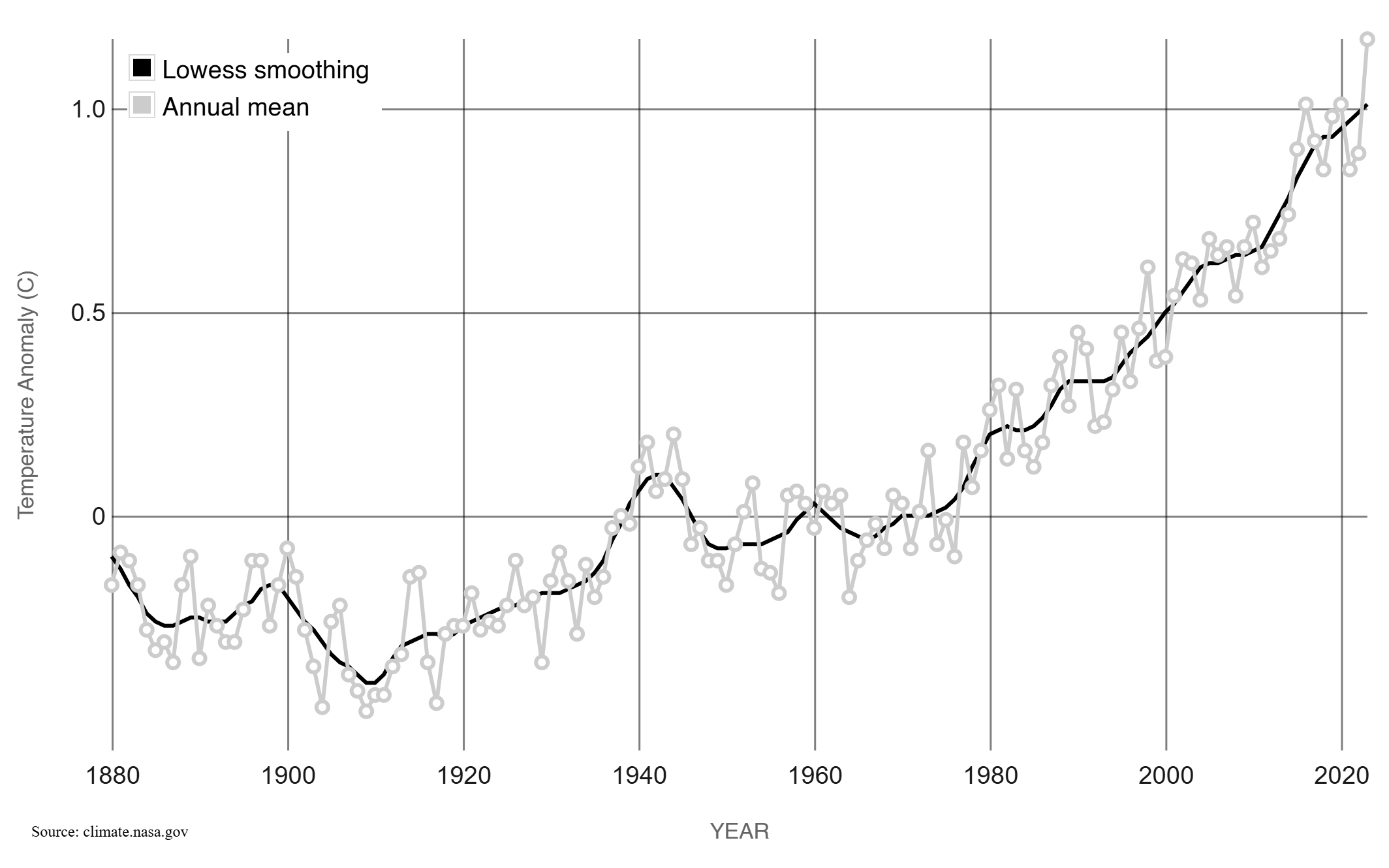
THE GLOBAL LAND-OCEAN TEMPERATURE INDEX
from NASA’s Goddard Institute for Space Studies (GISS). Picture: NASA/GISS
The data showed the Earth’s average land and ocean surface temperature for the year was 2.32F (1.29C) above the 20th-century average — the highest global temperature among all years in NOAA’s 1850-2024 climate record.
And, as predicted 70 years ago, it was not a one-off – rising temperatures are a trend.
The NOAA says the planet’s 10 warmest years since 1850 have all occurred in the past decade. And in 2024, global temperature exceeded the pre-industrial (1850–1900) average by 2.63F (1.46C).
The problem many people have is in communicating this to us, the average person; ‘Global temperature’ this, ‘pre-industrial’ that, it all feels a bit ‘distant’, like it doesn’t actually affect us. We can’t see it. The river near our house is not flooding each day, we still have snow, and warm summers, so we can happily go about our lives and ignore Greta and her warnings, right?
This lack of effective communication creates a vacuum, which is happily filled by those who, perhaps, have a vested interest in not explaining what climate change actually looks like – and what it means in the future.
Who they might be, or why they would wish us to ignore the man-made aspects of climate change, is anyone’s guess.
However, those opposed to heeding the warnings of Teller 70 years ago and oil industry reports a decade later, continue to pretend the world isn’t warming up.
For example, immediately after the data showing 2024 as the warmest year on record was released, a website called the Daily Sceptic posted a story under the headline, ‘Arctic sea ice soars to highest level for 21 years’.
Good news, you may think – and so did many others, who shared the story widely, with some claiming it showed how “global warming is a massive con”.
According to Reuters, one post featuring the story – and claiming it was proof climate change was not real – was shared more than 5,000 times on social media.
However, as the Reuters Fact Check team went on to show, the story was wildly misleading.
Indeed, on January 8, 2024, the sea ice extent was greater than it was on January 8, 2004. But what happens on a single day does not a trend make.
What the Daily Sceptic article did was cite that single day’s data – which said there were 13.68 million square kilometres of Arctic ice on January 8, 2024, compared to 13.64 million sq km recorded on January 8, 2004.
But as experts pointed out, this is not a trend.
For example, according to Walt Meier – a senior research scientist at NSIDC – during large parts of February and March 2024, ice levels were lower than during the same periods in 2004. But the Daily Sceptic didn’t report that. And even if it did, that too does not, in isolation, represent a trend.
“Comparing two specific days from two specific years is not an indicator for or against long-term changes,” Meier said. “The sea ice varies from day to day and from year to year.”
A better indicator of the trend, he said, was the lowest level of sea ice in the Arctic each year. And NSIDC data shows those levels are falling.
Miguel Maqueda, an expert in the modelling of sea ice from Newcastle University, went on: “Current sea ice extent in the Arctic remains lower than the long-term 1981-2010 average.
“There is no evidence nor reason to believe that the downward trend in winter sea ice extent in the Arctic is coming to an end.”
And it is also not the only measure by which to judge the existence of climate change – a point made by Gaëlle Veyssiere, a sea ice physicist from the British Antarctic Survey.
Gaëlle told the Reuters team: “Even if sea ice was partially recovering in the Arctic, which it is not, you cannot deny the other markers of climate change on Earth that are not related to sea ice per se, but are still true.
“You can’t deny climate change based on a single marker that fits your narrative.”
Oh, some can Gaëlle, some can. And they do.
For a long time, one notable climate ‘sceptic’ (for lack of a better term) in UK politics was the Reform UK party, which claimed in the ‘energy and environment’ section of its website that working towards net zero “means reducing man-made (carbon dioxide) emissions to stop climate change”.
Spoiler alert: That’s not what the aim to reach net zero means.
Reaching net zero aims to reduce the amount of carbon dioxide we pump into out atmosphere to a level where we are not adding to it – where the amount is ‘net zero’, hence the name.
It would mean we are no longer increasing the amount of carbon dioxide being emitted into the atmosphere. It does not claim to “stop climate change”. It could, however, slow the rate of warming and preserve life on this planet for as long as possible. No harm in that, right?
Not according to Reform UK. They see a lot of harm in that.
“We are better to adapt to warming, rather than pretend we can stop it,” the party’s website said.
As a bit of an aside, I would be intrigued to hear how Reform UK think those living in poverty can ‘adapt’ to climate change should their homes be wiped out by flooding, or how those (often very wealthy people) affected by the current devastating wildfires in the US (which many believe are worsened and more common due to climate change) can ‘adapt’ right now and save their homes?
Anyway, in fairness to Reform UK, the claims above are not in their most recent manifesto, or as they call it, their ‘Contract With You’.
But what is there is still staggeringly disingenuous, to say the least.
For example, the ‘contract’ says how “bills have increased dramatically in line with the huge increase in renewables capacity over the last 15 years”.
This is correct, bills have risen. And yes, the amount of renewable energy capacity has also risen.
But that is not why bills have risen.
(As a fictional president once said, ‘post hoc ergo propter hoc’ – ‘after it therefore because of it’ – is almost never true, which is a good excuse to include a West Wing clip here.)
Renewable energy is, in fact, cheaper than that produced using fossil fuels.
Our bills have risen for a raft of other reasons, including the Russian invasion of Ukraine, for example.
Another reason is a bit more complex – and again, leads to a difficult communications mission trying to make that clear to you and me. It’s called the ‘marginal cost pricing system’.
I’m no expert in energy markets but I’ll do my best – using the help of others – to explain it.
So, we all understand energy generators sell electricity to suppliers, who sell it on to you and me, the customer.
Generators – suppliers – customers. Got it.
Suppliers, around 40% of the time, buy this energy on what is called a ‘spot market’ (like buying produce at a wholesaler) a few days ahead of us needing that electricity.
The price they pay is passed on to us, as part of the generator-supplier-customer chain.
What that price is, is where the marginal cost pricing system comes in.
A House of Commons explainer on the issue (entitled, ‘Why is cheap renewable electricity so expensive on the wholesale market?’) defined it like this: “Marginal cost pricing is where units of electricity are sold at the price of the most expensive unit needed to meet demand at a particular moment in time.” (emphasis mine)
It went on: “In each half-hour trading period, each electricity generator bids the price it will accept to generate electricity, according to how expensive the electricity is to produce.
“The bids are accepted in ‘merit order’ until the demand for electricity is met; the cheapest first, and the most expensive last.
“However, the price of all units of electricity is set according to the bid price of the most expensive unit needed to meet projected demand: this is the ‘marginal cost’.”
Note, “the price of all units of electricity is set according to the bid price of the most expensive unit” – the price we, the customer pays, per unit of energy is set by the most expensive on the ‘spot market’.
The most expensive unit…
Another teaser for you – guess which generators typically produce the most expensive unit?
It’s fossil fuels. Have yourself a cookie if you guessed correctly.
The Commons document goes on: “Renewable generators typically have the lowest costs (because they do not have to buy fuel to burn) and so are the first to meet demand. Fossil fuel generators (including gas) often have the highest costs as they must buy fuel to burn, which also has a carbon price on it.
“As a result, although most electricity is produced using sources with low marginal costs (42% by renewables and 15% from nuclear), the price that is paid for electricity traded on the spot market is often higher, at the marginal cost of generating electricity with gas.”
So let’s be clear: Our bills are not higher because renewables. They are higher because of fossil fuels.
Renewable energy is cheaper to produce than fossil fuel energy, and is getting even cheaper. And when you factor in other considerations (Russia-Ukraine), combined with improving technologies, it is set to get cheaper still.
But if a supplier is using the spot market, which 40% of energy sold is bought using, we are all paying to generate our electricity by the most expensive method – usually gas.
So what should we do? Well, perhaps make more energy through cheaper, renewable sources? Seems like a no-brainer to me!

An example of how the marginal cost pricing model works – and how prices are affected. Source: House of Commons Library
Because rather than bills rising due to renewables, as people like Reform UK imply, in many cases it is exactly the opposite – our bills are actually rising due to fossil fuels. If we produced *more* electricity using renewables, we could meet the demand at the lower price – bringing our bills down.
So, the sooner we make the enough electrcity generators renewable, the sooner we get to enjoy cheaper energy – particularly when using the spot market/marginal cost pricing system.
This is why you have seen recent governments pledge to increase funding for nuclear energy, for example, and yes, why renewables receive government funding. It will help *us* in the long run. It doesn’t hurt us, as Reform UK claims – and is still claiming – it will SAVE YOU MONEY and HELP THE PLANET.
I hope that explains why Reform UK’s contract claim that “Net zero is pushing up bills” is simply not true, not really. The move to net zero could, if pursued, lower bills considerably – and the faster we get there, the better, from a cost-of-living perspective.
It’s not a political statement to say that, it is a fact – and one we should all be able to agree on – just as it is widely accepted as fact rising levels of man-made carbon dioxide in our atmosphere are contributing to rising temperatures on the planet.
Moving to renewables would bring down our bills and – and let’s pretend there is some doubt – *might* help our planet. It’s a win-win. A no-brainer. Simple.
If only someone had warned us of all this 70 years ago…
PAUL JONES
Editor in Chief
REFERENCES: I have done my best to make each reference to data a link to the course in the first instance. If any are missing, let me know.
Feel free to send me your thoughts on this article – and anything else you think I should have a look at (I’ve got one coming up on pets) – by emailing me via paul@blackmorevale.net. Please, just keep it civil.
Meanwhile, you can read more of my opinion pieces using the links below:
- OPINION: Petitions, petitions, and why snowflakes need to get over it…
- OPINION: ‘There is no shame in acknowledging the shameful’
- OPINION: My idea to solve our prison and employment crises
- OPINION: ‘Please, boomer, stop telling us how hard you had it’
- OPINION: Why Liz Truss would be the perfect next Tory leader
- OPINION: ‘Prime Minister, I’m not angry, I’m just disappointed’







Leave a Reply