


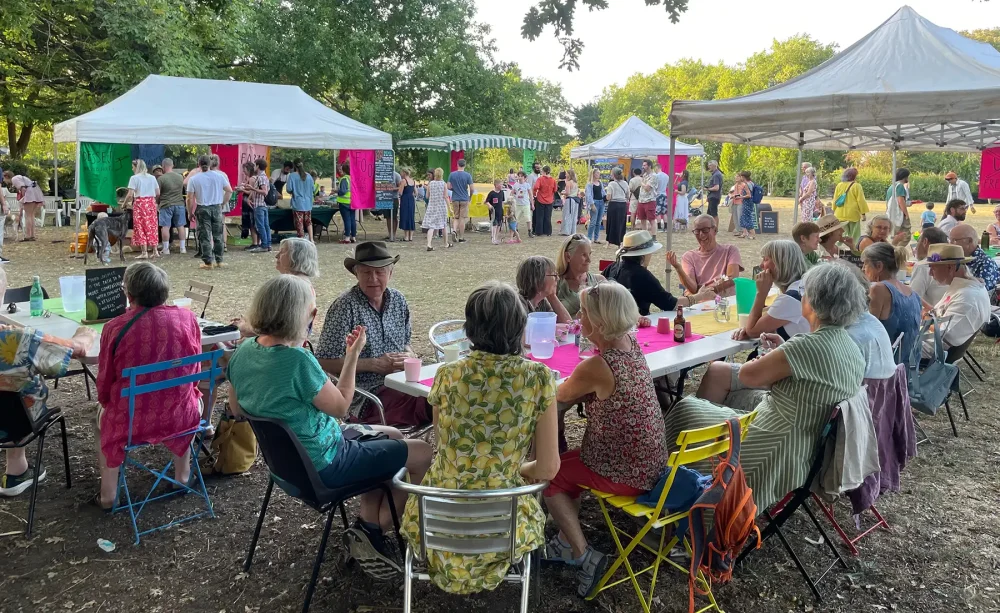
A SOMERSET pay-what-you-can community restaurant took a step outside this month in a first for the project.
Earlier this month the Canteen restaurant project – run by the Frome Food Network and supported by Future Shed, part of Green & Healthy Frome – served up more than 220 plates of food outside the Victoria Park Café.
The scent of hogget shawarma and home-grown herbs filled the air as neighbours, families, and strangers came together for a meal with a difference; Some paid in full, some subsidised, and a few gifted entirely. No one was turned away.
It was the first time Canteen ventured outdoors, with a menu featuring a potato salad at its heart, made using 600 potatoes grown by more than 100 families, schools, care homes and businesses across the town.
Surplus food from the local Community Fridge became pudding, with leftovers redistributed to ensure nothing good went to waste.
“It was, in many ways, a simple community supper,” a spokesperson said. “But it raises a bigger question: why don’t more towns and councils create spaces like this for people to eat together?”
Canteen points to a number of places around the world where community eating is commonplace, such as Spain, where paellas are cooked to feed entire towns during festivals, often using surplus food, and Japan, where children eat identical school meals side by side, learning nutrition and reinforcing community bonds. In India, Sikh gurdwaras have served free, communal meals – langar – for centuries, embedding equality and dignity into every dish.

Community paellas are common in Spain. Picture: Ggoaga/Pixabay
Even in the UK, during World War II, government-backed British Restaurants provided communal, non-profit dining centres that served cheap, nutritious meals for workers and those made homeless by air raids.
Canteen said communal meals encourage healthier diets and reduce food insecurity, while bringing social connection, education and food resilience.
“Run by the Frome Food Network and supported by Future Shed, part of Green & Healthy Frome, Canteen is part of a wider effort to link health and climate,” the spokesperson added. “The principle is simple: what’s good for the planet is often good for our health too.
“With two-thirds of British adults now overweight or obese, and The False Economy of Big Food estimating that the UK’s unhealthy food system costs around £268 billion a year, projects like Canteen offer a glimpse of a different future.
“From sustainable farming practices that produce nutritious food, to reducing food miles by buying locally, to giving everyone access to affordable, healthy meals and increasing social cohesion – the benefits are cyclical.
“Better food systems support local economies, improve public health, reduce strain on the NHS, and build resilience against climate change.”
READ MORE: Frome news from your Somerset Leveller
They added: “As laughter rose over the long tables, children dashed across the grass and strangers became neighbours. Frome offered a vision of a fairer, healthier, more connected society – served up on real plates, not buried in policy papers.”
At the end of the evening, 222 meals had been shared, with an average spend of £10.83.
Because, the spokesperson said, “at Canteen, no one eats alone, and everyone is welcome”.
“But the real question is not whether Frome can keep Canteen going,” they went on. “In an era of rising loneliness, growing health inequalities and strained local services, shouldn’t councils across the UK be investing in communal eating as part of public health?
“If other countries treat shared meals as central to wellbeing and education, why not Britain too?”
For more information about Canteen and the work of Green & Healthy Frome, visit greenhealthyfrome.org.





Leave a Reply