


AT around 10.30pm on December 4, 2019, I heard a loud bang and the earth, quite literally, felt like it moved.
Sadly, I was sitting at the kitchen table doing some work and not engaged in anything more fun, so it came as quite a shock.
I thought perhaps a lorry had crashed outside our house at the time, in Taunton, so rushed outside to see what had happened.
Nothing. The street was deserted.
I returned to the table to see if I could find any information online.
Others were taking to social media to say they too had felt the earth move. And not in a good way.
I started searching more and eventually found the British Geological Survey (BGS), which records seismic events in the UK and, sure enough, it appeared what we had experienced was an earthquake.
Data from the BGS showed the epicentre of the Somerset quake appeared to have been Huntworth, near Bridgwater, and measured around 3.5 on the Earthquake Magnitude Scale, which is defined as being ‘light’.
“Often felt by people, but rarely causes damage,” the definition says.
Well, a lot of us felt it in Somerset that night.
Memories of that chilly December night came flooding back this month, of course, as news broke of a large earthquake in Taiwan.
The quake, measuring around 7.4, struck the country on Wednesday, April 3, and at the time of writing, had taken 10 lives.
But back to our little corner of the UK, here in Somerset.
After hearing of the tragedy in Taiwan, I went back to the BGS and scoured the data once again and it turns out, we have earthquakes in Somerset surprisingly regularly.
BGS recorders detail at least three so far this year – two centred on Highbridge, another on Middlezoy.
The largest, on February 18 this year, was epicentred on Middlezoy, a small village on the Levels between Westonzoyland and Othery, not far from Bridgwater, if you don’t know it.
It registered 2.2 on the scale, defined as being ‘minor’ on the scale, and “usually not felt by people”.
But if the earth moved for you in the Middlezoy area that night, it could have been that…
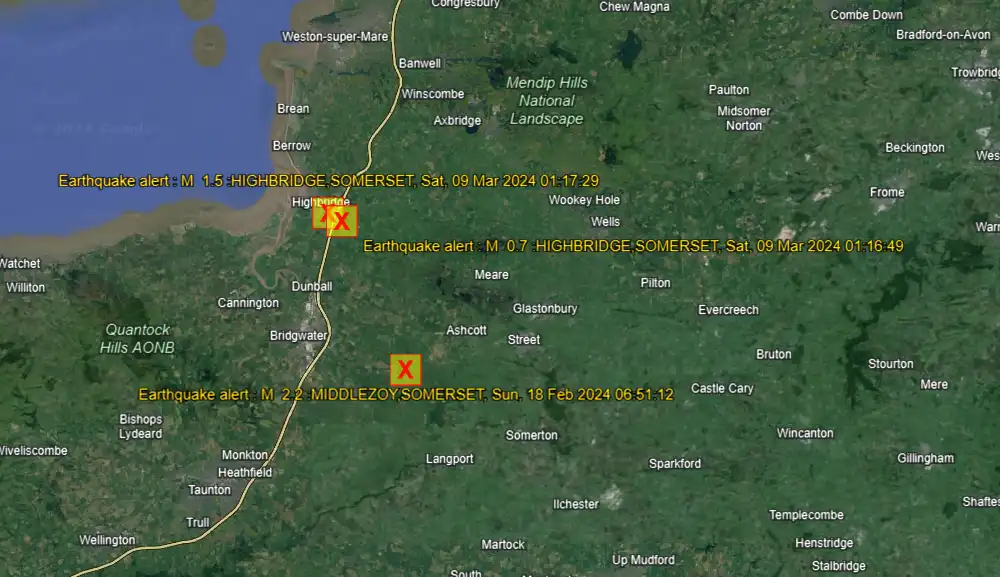
Recent earthquakes detected in Somerset by the British Geological Survey (BGS)
“Earthquakes don’t kill people, buildings do”
It’s a well-known quote among studiers of all things seismic, indicating that rarely is a quake large enough, or does enough damage to the physical environment, to harm people.
It is buildings collapsing that causes injury and, horrifically, deaths.
In the UK, as we are a low-risk region for strong earthquakes, building regulations state “seismic design is not usually required” for most buildings, while others should carry out a risk assessment and “consider if there is any need to carry out seismic design”.
So in the UK, our buildings are not designed to withstand any major quake, though they have shown to be resilient to low-level seismic activity, such as in 2019.
Global warming and earthquakes
The impact climate change might have on seismic activity has been a subject of much speculation.
Could the changing climate mean more, or fewer, earthquakes?
US space agency, NASA, and others have conducted research into the possibility. And there could be a link.
It all comes down to stress on the Earth’s crust, which in turn can impact on the movement – or lack of – in tectonic plates which cause earthquakes when they move.
For example, a 2017 study by NASA showed this can be significant.
In the study, it was found a series of droughts and heavy precipitation (rain, sleet or snow) in the Sierra Nevada between 2011 and 2017 actually caused the mountain range to rise by nearly an inch and then fall by half that amount, as water levels in the rocks increased and decreased.
“The study didn’t specifically look at potential impacts on faults, but such stress changes could potentially be felt on faults in or near the range,” according to geophysicist Paul Lundgren, of NASA’s Jet Propulsion Laboratory in Pasadena, California.
But he said it gets much more difficult to make such inferences about larger earthquakes.
“We’ve seen that relatively small stress changes due to climate-like forcings can effect microseismicity,” he added.
“A lot of small fractures in Earth’s crust are unstable. We see also that tides can cause faint Earth tremors known as microseisms.
“But the real problem is taking our knowledge of microseismicity and scaling it up to apply it to a big quake, or a quake of any size that people could feel, really.”
Climate-related stress changes might or might not promote an earthquake to occur, but we have no way of knowing by how much.
“We don’t know when a fault may be at the critical point where a non-tectonic forcing related to a climate process could be the straw that breaks the camel’s back, resulting in a sizeable earthquake, and why then and not earlier?” Mr Lundgren added.
“We’re simply not in a position at this point to say that climate processes could trigger a large quake.”
So, the type of earthquakes we experience – surprisingly regularly – here in Somerset, could indeed by influenced by the climate.
But it doesn’t help us predict when an earthquake, or a volcanic eruption, might happen, according to Lundgren.
“We’re not close to being able to predict when an earthquake may occur as a result of climate processes,” he concluded.
“Even if we know that some outside climate process is potentially affecting a fault system, since we don’t know the fault’s potential state of readiness to break, we can’t yet make that extra inference to say, ‘Ah ha, I might get a quake a week or a month later’.”
So, while it may surprise some of us, the earth actually moves quite regularly in Somerset. But more often than not, you have no way of knowing when it might happen, and you probably won’t notice anyway…







Leave a Reply