


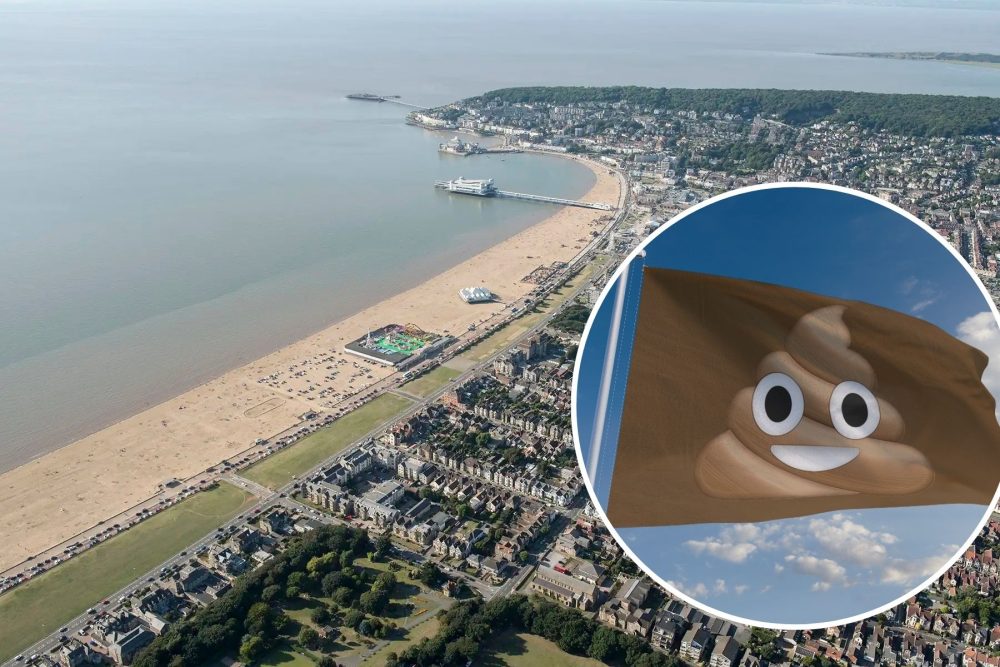
THREE Somerset beaches have been named and shamed in the second annual Brown Flag Awards – while the county was also named the second worst in England for overall water cleanliness.
UK travel site Holidayparkguru.co.uk analysed official Environment Agency (EA) summertime water quality data from hundreds of beaches to reveal the 19 grubby ‘winners’.
In Somerset, beaches featured in the ‘list of shame’ are Weston-super-Mare, Dunster Beach and Blue Anchor.
Brown Flag beaches are those rated ‘poor’ by the Environment Agency due to bacteria such as e-coli from sewage and other waste.
Blue Anchor – known as Blue Anchor West by the EA – is classed as a ‘Newcomer’ – or ‘Poocomer’ – because it has won a Brown Flag Award for the first time.
Dunster Beach is a winner for a second time after picking up a Brown Flag Award in 2024, while Weston again received a ‘poor’ rating at three different testing points on the beach – but gets just one overall Brown Flag Award.
Overall, the number of Brown Flag beaches in England leapt up from 13 in 2024 to 19 in 2025 – a 46% rise.
READ MORE: Brown Flag Awards for dirty Somerset beaches among worst in the UK
And Holidayparkguru.co.uk is once again offering free brown flags – each tastefully decorated with a poo emoji – so the 19 winners can warn summer swimmers about their poor rating.
Somerset was the only county that took up the generous offer last year – with the flag used by campaigners during a clean water protest.
Overall, just 10% of Somerset’s beaches are rated as ‘excellent’ for water cleanliness, putting the county in 18th place out of England’s 19 coastal counties.
Northumberland, Dorset and Devon are the highest rated counties, with scores around 90%.
Lancashire came bottom of the league table, with none of its beaches being graded as ‘excellent’ for water cleanliness.
Other big name ‘winners’ of Brown Flag Awards include beaches in Blackpool, Bognor Regis and Worthing.
Campaigner and sea-swimmer Robbie Lane, from HolidayParkGuru.co.uk, said: “We had hoped that we’d be handing out fewer Brown Flags this year – but things have gone down the pan.
“For Somerset, the bad news is that it’s picked up three Brown Flag Awards – that’s the joint highest number of all the English counties.
“It also ranks very poorly in England’s league table of clean beaches.”
He urged people to do their research before hitting the beach this summer.

Dunster Beach also received a Brown Flag Award for 2025. Picture: Google
Brown Flag Awards Winners 2025 for ‘poor’ Environment Agency ratings were (in alphabetical order by county:
1. Porthluney in Cornwall
2. Coastguards Beach, Erme Estuary in Devon (Newcomer for 2025)
3. Lyme Regis Church Cliff Beach in Dorset (Newcomer for 2025)
4. Southsea East in Hampshire
5. Deal Castle in Kent (Newcomer for 2025)
6. Dymchurch in Kent (Newcomer for 2025)
7. Littlestone in Kent
8. Blackpool North in Lancashire
9. St Annes North in Lancashire
10. Heacham in Norfolk
11. Weston Main, Weston Super Mare Sand Bay and Weston Super Mare Uphill Slipway in Somerset
12. Dunster Beach in Somerset
13. Blue Anchor West in Somerset (Newcomer for 2025)
14. Bognor Regis, Aldwick in Sussex
15. Worthing Beach House in Sussex (Newcomer for 2025)
16. Tynemouth Cullercoats in Tyne and Wear
17. Littlehaven Beach in Tyne and Wear (Newcomer for 2025)
18. Scarborough South Bay in North Yorkshire
19. Bridlington South Beach in East Riding of Yorkshire
NOTE: Some large resorts have several beaches and testing points, and it may just be one section of the beach that is designated as being ‘poor’.
HolidayParkGuru.co.uk’s County-by-County League Table for Clean Beaches in England:
Percentage of beaches rated ‘excellent’ by the Environment Agency for sea water cleanliness, from best to worst, along with their position last year:
1. Northumberland: 92% (↑5 places compared to last year)
2. Dorset: 87% (↓1)
3. Devon: 86% (↓1)
4. Cornwall: 82% (=)
5. Lincolnshire: 78% (↑2)
6. Hampshire and New Forest: 73% (↑2)
7. Isle of Wight: 73% (↑2)
8. Norfolk: 69% (↑6)
9. Suffolk: 67% (↓6)
10. Yorkshire: 52% (↑6)
11. Essex: 50% (=)
12. Tyne and Wear: 50% (↓7)
13. Sussex: 47% (↓ 1)
14. Kent: 42% (↑1)
15. County Durham: 33% (↑2)
16. Merseyside: 29% (↓6)
17. Cumbria: 25% (↓4)
18. Somerset: 10% (=)
19. Lancashire 0% (=)
The Brown Flag Awards used EA data taken from around 7,000 samples at more than 400 bathing waters, which the EA says is ‘calculated annually based on samples from the previous four years’.
Water quality readings look for intestinal enterococci and escherichia coli (e-coli) levels to see whether there is ‘faecal matter’ in the water. This comes from ‘sewage, agricultural livestock, wildlife, birds and road drainage’, according to the EA.
Readings are taken from May 15 to September 30. During the winter, water quality tends to be lower along England’s coastline as higher rainfall causes more sewage and waste water to overflow into the sea and into rivers.








Leave a Reply