


“IT all changes when you have children”.
The comments were usually accompanied by a roll of the eyes and a puffing out of the cheeks.
“Just you wait,” they’d say. “It’ll all be different then.”
As someone who has been a festival goer for more than two decades, expecting a first child with a wife who had also enjoyed drinking and listening to music in various fields across the UK, these remarks usually came as we discussed which gatherings we were attending that summer.
They were right, of course. It does indeed ‘all change when you have children’.
But change is the operative word – ‘change’, not ‘stop’ – as so many no doubt expected.
Festivals are still among the highlights of our year – Glastonbury in particular.
So it matters to us – and now, to our children too, them having been in attendance at Worthy Farm since they were babies. It never ceases to amaze some folks when our eldest, who is nine, tells them she’s been to Glastonbury five or six times.
But it really is a way of life, a pilgrimage, a treasured time.
Yes, things have changed. And not only for us.
‘QUEUE here to complain the festival is not as good as it used to be.’
So read the sign in a far-flung corner of Worthy Farm. I saw it a few times, and it never failed to raise a smile.
The refrain is heard so much from, shall we say, veteran festival goers.
Now, I dare say I might qualify for such a tag in some quarters, though it’s not something I ever strive to portray, or think gives me more knowledge or right to attend than anyone else.
For it is not only me that’s changed, has had to change – festivals have too.
Glastonbury, for five days, becomes one of the most densely populated places on Earth. It is enormous.
With that comes some responsibility; to the land, the people, the performers. But also to the history and heritage of the event.
Over the years it has evolved, as have we all – sometimes for the better, sometimes for the worse – but without change there is no progress.
Right now, the Glastonbury Festival of Contemporary Performing Arts is at a crossroads.
The direction it takes from here will be, for this reluctant ‘veteran’ and the event itself, huge. And this direction is perhaps most symbolised by the choice of headliners…
THERE’S no avoiding the fact this year’s line-up was not what many expected.
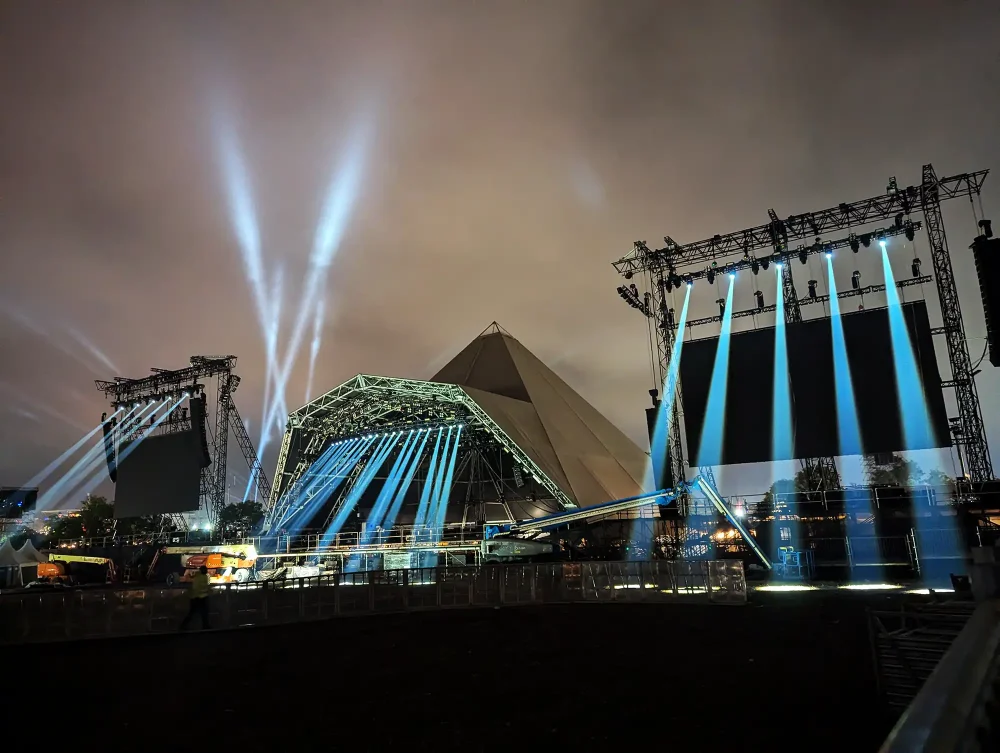
For now, let’s focus on headliners of the Pyramid, that behemoth of stages and quite literally the focal point for those on site – and millions around the world.
At the Glastonbury crossroads, the first turn is for Dua Lipa.
She is currently an icon of the pop world and was worth a punt as a Friday-night headliner, in this reviewer’s opinion.
Did it pay off? For me, yes – just.
Glastonbury is about embracing new things, new genres, sounds and styles, and the 28-year-old certainly put on an impressive show.
The one niggling reservation I have – and it applies to all the 2024 Pyramid stage headliners – is who that show is for? For the performance came over far, far better on television than it did in the field.
At Worthy, unless you were front and centre, you hardly saw her. The stage design, lighting, everything, seemed almost designed for television rather than the tens of thousands in that field.
READ MORE: Glastonbury 2024: Five fantastic acts you might have missed
READ MORE: Langport youngster, 5, wins prize after Glastonbury Festival debut
It looked great on TV, when watching back, but what I was watching seemed detached from my experience being there, which was good, but somehow separate from us in the field.
Which is perhaps exactly what she and her team wanted. There aren’t many streams or downloads to be secured for Dua Lipa from your average Glastonbury goer, rocking on aching feet after walking for miles in at times searing Somerset heat, I’d argue.
But it was fun, upbeat and slick. And a young British/Albanian songwriter on one of, if not the, biggest stage in the world? It’s a win.
We all went home to our tents, or off into the wider Glastonbury world, satisfied that night.
On to Saturday, and Coldplay. Ah, Coldplay. A legend of those fields, no doubt about it, but a fifth time? Really?
I have to wonder if a headlining slot at Glastonbury is part of the marketing schedule for new Coldplay albums, as it now feels like a launch party, a PR event, when they play.
What gimmick will it be this time? Which celebrities will be in the crowd? Who will they bring out on stage with them?
Believe me, I adore Michael J Fox (I got many a rollocking from my mother as I tried desperately to cling to the back of her VW Polo on my skateboard as a youngster, The Power of Love blasting through my Walkman headphones), but his appearance feels like part of a checklist somehow.
It may be harsh, and you cannot doubt the good intentions of Chris Martin and his merry men, but it all feels a little synthetic – too well produced.
Celebrity in crowd? Check. Colourful backdrop and fireworks? Check. Bring out an unexpected guest? Check. Successful launch for new material? Absolutely.
Call me cynical, but it does have that feel.
I am a fan of Coldplay at Glastonbury, they ‘get it’, and they never disappoint. But it just doesn’t feel fresh anymore, it feels like a bucket-list exercise for the bucket-list festival goer.
Again, perhaps that is exactly what it is intended to be. Coldplay are almost as obligatory as a selfie in front of the Pyramid stage.
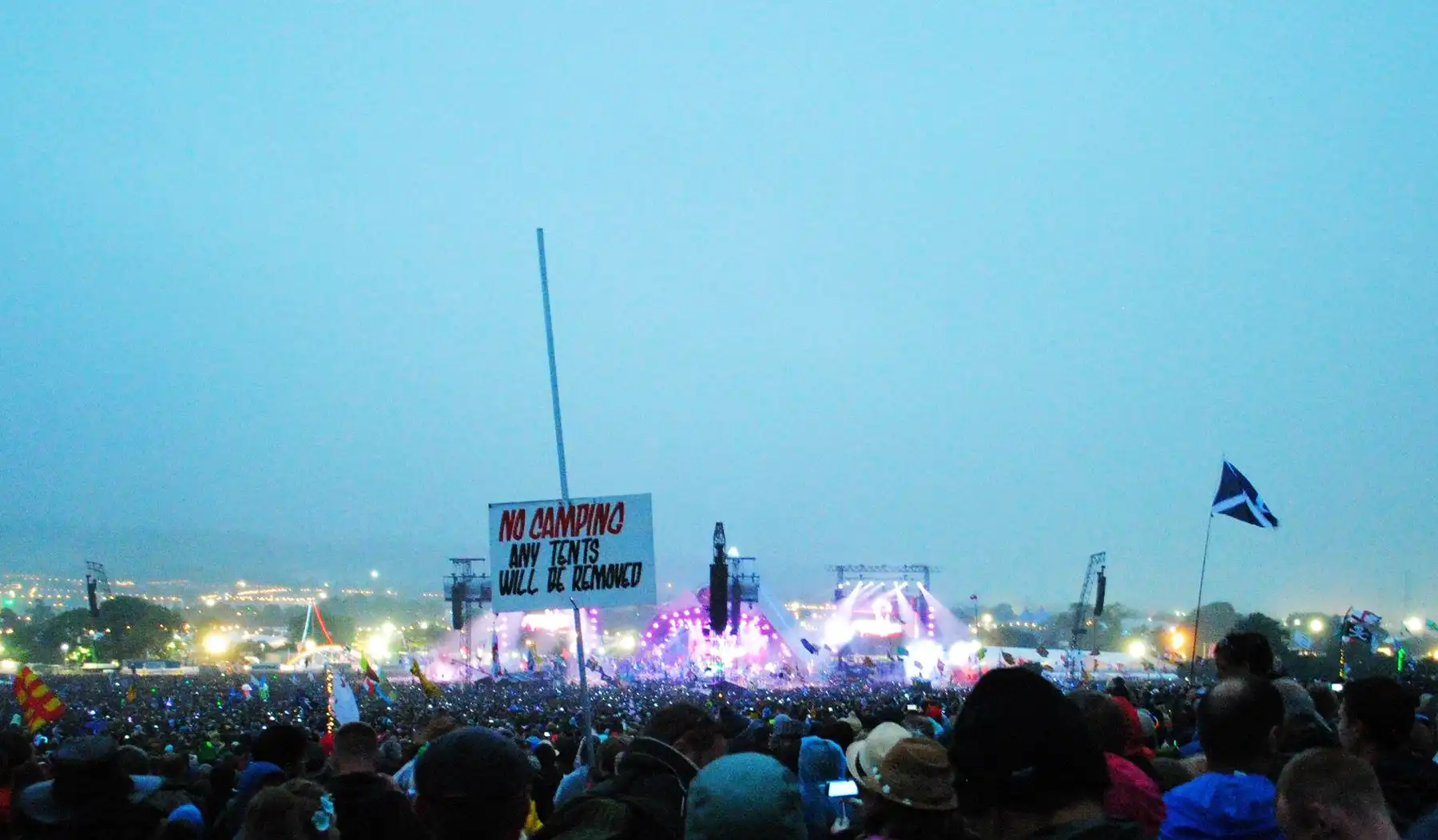
Coldplay handed out thousands of illuminated wristbands in 2017. Picture: Paul Jones
To Sunday, and SZA.
This is where things get a bit sticky.
When first perusing the line-up, being of a certain age and heritage, I was unaware of any of her music. But that’s fine, I am not a devoted follower of the latest trends, artists and genres, as I once was, so I simply deduced she must be a big name I was unaware of. And she is.
Her voice is absolutely outstanding, and her music – even though it’s really not my thing – is clearly genuine, real, and has a mass appeal.
Yet streams do not a Glastonbury headliner make.
There’s an unquantifiable something about a really successful Pyramid headliner. And for SZA, this year, it just wasn’t there.
Much has been made of the size of the crowd at her set, and there may be something to that, which is of course completely beyond her control.
But this slot is a tough one to fill – for the booker as much as the artist. It needs the right act.
The closing Pyramid set should be a feelgood farewell; a mass, uplifting event, to send us all on our way back to the real world with a spring in our step and hearts full of joy. Someone like, I dunno, Coldplay?
Unfortunately, for whatever reason, this was not that.
AS we approach those crossroads, the three forks in the road – Dua Lipa, Coldplay and SZA – almost perfectly represent the choices facing our beloved festival.
There’s no doubting the weight of influence the TV cameras, the social media generation and the worldwide media have on what is, at its core, a huge concert in a field.
Glastonbury has become an industry in its own right, a commodity – and a hugely marketable one.
Booking headliners that satisfy the pull of each fork in that road must be a nightmare and mistakes will inevitably be made.
But there’s no doubt those factors have to be a consideration when booking acts.
Case in point – Seventeen. I had never heard of them, but again, that means nothing. But judging by the size of their crowd on the Pyramid, nor had a lot of other festival goers.
So why were they there?
K-pop is a huge genre – huge – and the UK has so far not caught up with the craze. Around the world, Seventeen enjoy a popularity comparable to the likes of Take That in their pomp.
But in the Somerset fields? Not so much. But around the world, via the BBC live stream, it will have brought Glastonbury to an entirely new audience.
Us devotees might not care, but the TV execs and perhaps those at the top of the Glastonbury management pyramid, do.
On that KPI, job done.
What it shows is that artistic merit and a worthy (sorry) back catalogue now have to compete with whether the performer will justify BBC investment (which must be huge to cover the legion of staff on site), as well as appeasing the Tik Tok generation, the Twitterati, while paying homage to the heritage of the event – and all those paying more than £300 to be there.
It is no longer good enough to be good enough.
Glastonbury now feels like it has extra criteria for headliners; will they improve the ‘brand’ and will the casual BBC viewer tune n to see them?
All three headliners looked amazing on the TV. All three are very, very talented. But so are many, many others.
Their problem? They’re not cool. They don’t chime with BBC expectations, they wouldn’t garner the same headlines, they don’t break new ground etc.
Discussing headliners last week, Emily Eavis revealed a lot when she told PA: “I think the line-up reflects what’s happening in the music world at the moment – there aren’t a lot of new rock acts to choose from if I’m honest.”
There are. But they are, perhaps, not quite marketable enough for ‘brand Glastonbury’ which, for better or worse, is clearly part of the consideration in this day and age.
I’m not bemoaning that, progress can only come through change.
But that aside, when did the headliner – particularly for a Sunday night, for example – have to be “new”? Some of the best Glastonbury sets have come from acts definitely not, “new”; The Who in 2007, Elton John in 2023, David Bowie in 2000, the Levellers in 1994 and yes, Coldplay’s numerous great shows.
That said, if an algorithm existed to pick Glastonbury headliners for 2024, what we got would probably have been close to what it selected.
They all looked great, they are all big stars and are hugely marketable.
I’m reminded of comments made by footballer Roy Keane when, bemoaning the state of the game in the multi-billion pound premier league era, he branded a chunk of the supporters at the ground the ‘prawn sandwich brigade’.
The game had changed, he said, and some of the effects were not necessarily for the better. The new football formula was undoubtedly right for Sky TV and millions of fans around the world. But in the ground, the experience was – perhaps – compromised. The demographic changed.
Part of the beauty of Glastonbury is that it has never had a formula. Many of the truly great performances have been a surprise – they did not come with pre-planned costume changes and camera angles mapped to the n-th degree to ensure maximum viewing pleasure.
Glastonbury, like those of us who love it, has changed. And rightly so. But sometimes, making those changes can fall flat.
Progress is an evolutionary process, and misjudgements will inevitably be made. No one can deny Glastonbury is a phenomenal achievement and a hugely successful event that provides a backdrop for hundreds of thousands of life-changing moments and memories.
Getting it right every time is an impossible ask. And there are now numerous forks in the road to negotiate when picking the flagship performers, making it even harder.
That fork in the road represents a huge and difficult choice for the direction of Glastonbury in 2025 – and beyond.
Change has come before, and we have to trust in the festival leaders who have seen us right in the past to do so again in the future.



Leave a Reply