


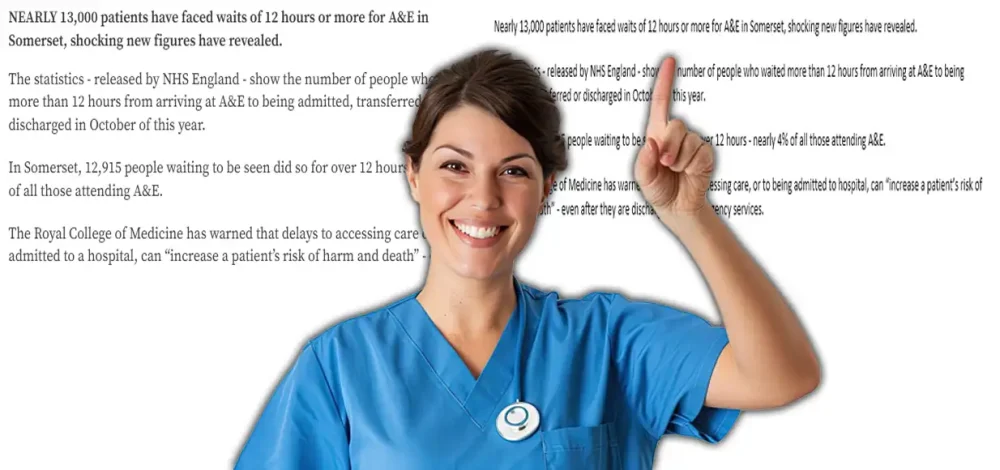
“NEARLY 13,000 patients have faced waits of 12 hours or more for A&E in Somerset.”
So the press release, issued by the office of Taunton & Wellington MP Gideon Amos, screamed from the inbox.
It included hard-hitting comments from the Liberal Democrat, who said: “Time can be critical when you’re waiting for treatment and long waits in A&E here in Somerset can be dangerous.
“The new Government must urgently get a grip of this crisis and bring forward a plan to rescue our struggling health services.”
One Somerset newspaper had soon posted the story verbatim, literally, with no response from the NHS in Somerset, or the Department of Heath and Social Care (DHSC). It came complete with the headline: “Gideon Amos MP urges government to ‘get a grip’ over health services”.
The intro highlighted the “shocking new figures” – in a direct copy and paste from the email issued by the MP’s office.
Alarming stuff, indeed.
The only problem is, it wasn’t true.
And the repetition of the release didn’t stop there. As you can see below, the story published by the newspaper was a *direct* copy and paste from the MP’s email.
The four opening paragraphs of the story visible in our screen grab are *exactly the same* as the press release.
Not one word changed. Not one.
Now, modern reporting is a different world to that of even 10 years ago, but this is still – I would hope – an outlier.
Such a blatant copy and paste is, let’s be honest, just bad work. And it really doesn’t help the reader – as we will see.
By way of contrast, your Leveller is different. I’m not trying to be self-righteous here, and please believe me when I say, I don’t like to criticise fellow reporters and publications directly – which is why I haven’t named the newspaper or reporter concerned.
I am not professing to being ‘holier than thou’ – we all make mistakes.
However, here at Leveller Towers, as we do with all such press releases, we sought to independently verify the figures. We do this for a number of reasons.
Looking at how folks like an MP (or council, or company) arrive at such claims, and the data used, can reveal a host of things; questionable analysis, downright dodgy figures, or another story that needs highlighting.
I can’t tell you how many press releases/stories I have not published or pursued because the conclusions drawn/figures ‘revealed’ were, at best, a bit iffy, and at worst, totally wrong or misleading.
And it wasn’t difficult to check here.
Mr Amos’ office had included a handy link to the data they had, apparently, used to put the release together, as this was not a deliberately misleading release.
So we checked it, as we would. And we were shocked by what we found.
Looking at the data from NHS England – cited by the MP (and in the copy and pasted story) – we could not find the ‘almost 13,000’ figure (12,915 to be precise).
There was no way we could match the claim. No matter how we tried to match the figures, we couldn’t do it. We couldn’t even get close.
Because the actual number of people who waited 12 hours was not 13,000. According to our table, it was 78. Yes, 78. But the number, really, is irrelevant. What was absolutely vital was that this press release had been taken as accurate and immediately posted, without any checks at all.
We contacted the NHS in Somerset to find out if there was something we were missing that meant we were coming up with the wrong figure. Was there some way the data could be sorted to reach such a vastly different total?
A reply soon came, informing us the number touted by the MP was ‘wrong’ and they were looking into it.
We went home, having not posted a story – preferring instead to wait until we could get accurate data and responses. We would hate to mislead readers.
Sure enough, later that evening, it was confirmed by the NHS in Somerset the actual figure was 78.
And in the morning, an email had also dropped in from the MP’s office, asking folks to disregard the press release.
Clearly, a mistake had been made – one we avoided repeating through the tiniest bit of fact checking and due diligence.
However, the story was still sitting prominently on the homepage of the newspaper, complete with dramatic headline and absent any response from the NHS or DHSC.
This is more than 12 hours after the release was issued.
An hour or so later, however, it was gone. Deleted. The whole story removed. No explanation, no correction, nothing.
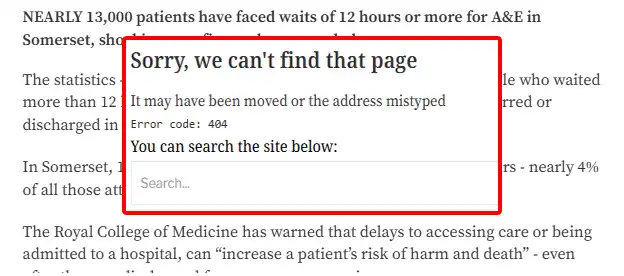
The original, copy-and-pasted story was deleted, with no clarification, correction, or apology
Now, as I say, I’m not one to call out fellow reporters in public – it’s a tough job, we’re all in it together, and we all make mistakes. ‘There but for the grace of God’, etc.
However, this example is bad. Really bad.
This is not just sloppy, or lazy reporting, though it is both of those things. This story was fundamentally misleading. 13,000 is not 78. It’s not close. It’s a different world.
Thinking 13,000 people waited 12 hours at A&E for care is frightening. It could affect how you fundamentally view our NHS. It might even affect how you behave – if you think you’ll wait half a day to be seen, would you bother going to A&E?
And, at risk of navel gazing somewhat, it’s also a really scary insight into where my beloved local journalism is, right now.
For this was not a difficult story to check. The link to the data was in the same email the reporter copied and pasted.
I checked it. I’m sure others did too. And I found a massive error. An unintentional one, but an error all the same, which meant we did not publish the story.
The other Somerset paper, it would appear, simply didn’t bother to give the information even a cursory check, and published it without another thought.
It literally copied and pasted the press release and sent it live, hoping thousands of people would read it.
It didn’t bother to ask the NHS for a response which, even if the 13,000 figure had been correct, is needed, in my opinion. The NHS may have valid reasons for such long waits, may be making efforts to correct them, might have seen a problem with the data, etc.
Either way, it should have been asked to explain itself. Ditto for the DHSC. But they were never asked, it seems. They may choose not to respond, but they should still be given the chance, as that would help inform the reader.
Instead, an MP’s wildly inaccurate press release – a genuine mistake – was simply slapped up, verbatim, for people to believe.
Now, I am a defender of local media, whether it is a publication I work for or not. Local journalism is vital to our democracy, to our perception of the world we live in. Yes, it’s that important, in my view. And we will miss it when it’s gone.
But people should be able to trust their local newspaper.
Now, however, there are people walking around believing 13,000-odd people waited 12 hours at A&E when, in fact, it was 78.
And don’t get me wrong, 78 is still too many, is still worthy of a story. But it’s not 13,000.
Journalism is not what it once was. And I hate to sound like an out-of-touch old hack when I say that, because I’m not. Honestly.
The press release has been the modern equivalent of the conversation, or phone call to a contact, for a long time now.
I was part of the ‘old school’, of daily meetings with the police sergeant, of actually going to court to cover cases, etc.
But the fact is, using an emailed press release instead of a spoken word from a copper who only tells you what he wants to tell you anyway, is not really much different – despite what many old hacks would like to think.
Reporting has, to a large extent, always been and always will be, solely reliant on the information you are given, and no amount of face-to-face contact will change that.
Genuine scoops can be different, and they have suffered through the loss of ‘proper’, old-fashioned beat reporting. But that’s a moan for another day.
The day-to-day job of reporting is much as it always has been – but is easier now, because we have email, and people whose job it is to disseminate information who help us get it.
But I don’t believe we are so far from actual reporting that we don’t click a link to check figures, particularly on something so important as NHS waiting times – something that matters hugely to our readers.
‘Nearly 13,000’ is sexier than 78, that’s for sure. But if it’s not true, it’s not true. And being wrong isn’t sexy at all. It’s shameful. We’ve all made mistakes, and it’s horrible. But it happens, and you have to own it.
Whether it’s fair to single out the reporter concerned or not, I don’t know. But publications need to be better. Yes, we all make mistakes – but this is one that should never have been made.
What it means is that, and it pains me to say this – I simply can’t trust that news source any longer.
This was such a fundamental error – and the copying and pasting, wholesale, of a press release so utterly shameful – that I wonder what else they are publishing that is totally, completely, wrong? What else is being put in front of me that has not been checked, that might be something emailed in by absolutely anyone and simply repeated, verbatim, which anyone could do? It forces me to confront a very difficult question: What is the point of this paper?
Which other of the stories they publish are, literally, exactly what dropped into the inbox, published with no basic checks, no re-write, absolutely no scrutiny whatsoever?
It has shaken my trust. And this is an organ I respected. One I have staunchly defended – along with those working on it, who are facing unseen pressures to hit targets and ‘drive audience growth’. I genuinely feel for them.
Using press releases is acceptable. Re-writing them is acceptable.
But simply copying and pasting and putting something directly in front of thousands of people – with absolutely no scrutiny whatsoever – is not acceptable.
And it has been worsened by the reaction.
There is no apology. No explanation. No accountability. The story is just gone.
As a young reporter, I was told the best way to handle a mistake – no matter how big or small – is to cop for it straight away and apologise. Pretending it wasn’t a mistake, or blaming someone else, simply delayed the inevitable – the apology.
Let’s be honest, if you mess up, folks understand. We all do it. But there is none of that here, it seems.
As a consequence, that error is now out in the world, completely unchecked and unchallenged. It will never come back, but it sure as hell should be acknowledged and apologised for.
We all come under scrutiny for our decisions and that is absolutely right. As a reporter, news editor and editor, I have always been happy to debate, to defend, and yes, admit when we get things wrong – which happens.
Otherwise, there is a big risk that trust is gone forever. If not now, in the future, as incidents like this gradually erode any belief we have in our local news organisations.
Deleting a story does not mean it never existed. And it’s not good enough.
Here is the opening of the press release as issued by the MP:
“Nearly 13,000 patients have faced waits of 12 hours or more for A&E in Somerset, shocking new figures have revealed.
The statistics – released by NHS England – show the number of people who waited more than 12 hours from arriving at A&E to being admitted, transferred or discharged in October of this year.
In Somerset, 12,915 people waiting to be seen did so for over 12 hours – nearly 4% of all those attending A&E.
The Royal College of Medicine has warned that delays to accessing care, or to being admitted to hospital, can “increase a patient’s risk of harm and death” – even after they are discharged from emergency services.”
And the opening of the story published on the news website:
“NEARLY 13,000 patients have faced waits of 12 hours or more for A&E in Somerset, shocking new figures have revealed.
The statistics – released by NHS England – show the number of people who waited more than 12 hours from arriving at A&E to being admitted, transferred or discharged in October of this year.
In Somerset, 12,915 people waiting to be seen did so for over 12 hours – nearly 4% of all those attending A&E.
The Royal College of Medicine has warned that delays to accessing care or being admitted to a hospital, can “increase a patient’s risk of harm or death” – even after they are discharged from emergency services.”
You can email me with any thoughts you might have, at paul@blackmorevale.net. Just please, be polite!
And you can read my other opinion pieces here:
- OPINION: There is no shame in acknowledging the shameful
- OPINION: My idea to solve our prison and employment crises
- OPINION: Please boomer, stop telling us how hard you had it…
- OPINION: Why Liz Truss would be perfect as the next Tory leader
- OPINION: Prime Minister, I’m not angry, I’m just disappointed…





Leave a Reply