


A SOMERSET woman who made more than 6,000 calls to the NHS 111 service in a single month is among those being helped by a new scheme.
Janet, not her real name, was initially barred from contacting the service after making thousands of phone calls to the healthcare provider.
However, in order to ensure she could still access care when she needed it, a request was made to the agents at Ubuntu – a new project formed by colleagues from the Somerset NHS Foundation Trust and the Community Council for Somerset (CCS) – which looks at alternative ways to help people making a large number of calls.
“To ensure continued access to emergency assistance, it was agreed with Janet to put in place a personal alarm system in close partnership with careline colleagues,” a spokesperson said.
“The system provided Janet with an alternative means to seek help when required – using a button on her phone to call for support.”
Ubuntu agents found most of Janet’s calls were made during weekends and evenings, when traditional support channels were unavailable.
“To mitigate this, collaboration with a local care provider was intensified by designating them as a primary point of contact, and arranging for them to be available during extended hours to accommodate Janet’s needs,” the spokesperson went on.
“Efforts were also made to enhance Janet’s support network and social engagement. She was introduced to the opportunity to volunteer at the library, providing companionship during weekends when she felt most vulnerable.”
READ MORE: New breast cancer unit at Yeovil Hospital to welcome first patients next week
READ MORE: Chair of Somerset NHS to stand down in next 12 months
And the steps improved Janet’s situation, with call logs showing after making more than 6,000 calls in April 2023, the number fell to 4,385 within a month, and then again to 785 in June.
In September 2023, the number of calls was just 29, and then in November 2023 it was six.
The name Ubuntu came from Africa – after an NHS staff member explained how it is used to describe the principle, ‘for one, for all’.
“The name Ubuntu originated from when an ethnographer visited an African tribe and placed some sweets in front of a group of children, saying ‘first to the sweets wins them all’,” said Karen Holden, Somerset NHS Foundation Trust’s associate director of clinical transformation.
“But the children took each other’s hands and calmly walked together to the sweets, so they could share them.
“The motto of the story is that in this tribe’s culture, there was a principle of Ubuntu – if one person gets everything, then everyone suffers, whereas by working together, everyone gets an equal share.
“It really resonated for us as a principle, and when choosing the project’s name, we wanted to keep the theme of personalised care at the centre of it, so we named it Ubuntu, knowing that we’d always need to keep explaining and reminding ourselves of the principle.”
Karen said the scheme was founded after staff noticed a number of people using NHS services on an “abnormally high number of occasions whose actual needs weren’t being met in a healthcare setting”.
“Our hospital teams are focused on dealing with individuals medical needs, and don’t have the capacity to be supporting patients who have complex, individualised needs,” she said.
“This particular group of patients have been in the healthcare system for a long time, not really having their needs met, so they become very disaffected and very disillusioned, often presenting to us quite angry.
“We had the sense that we needed to do something different, and that the medical approach we used in the past wasn’t working for this particular cohort of people.
“We therefore began a conversation with the team at CCS about whether there was an opportunity to do something a bit different, and together we set up an improvement project, which gave us the opportunity to look at how we could set up personalised care for these patients – we called it Ubuntu.”
Now, the scheme has been named as a finalist at the Health Service Journal Patient Safety awards.

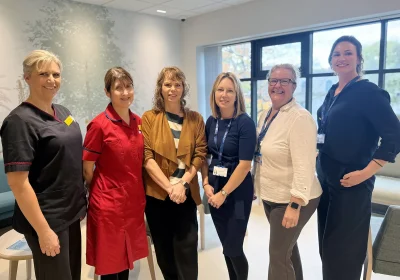
From left: Karen Holden – associate director of clinical transformation, Gayle Covey – consultant social worker and community mental health service team manager, Kristel Van Der Schyff – hospital team manager and Home First and Ubuntu lead at the Community Council for Somerset, Neil Thomas – high intensity use lead at the awards
Kristel Van Der Schyff, hospital team manager and Home First and Ubuntu lead at the CCS, said: “CCS is already deeply embedded within local communities, with staff visiting every patient referred to the service in their own home to gain a true understanding of the individual, how they manage, and the resources available to them locally.
“The Ubuntu team focus on taking the time to build professional, trusted relationships with each person. The result is a responsive, person-centred support system that taps into the individual’s community network as part of the solution, shifting the focus away from medical diagnoses and looking at the person as a whole.
“Every solution is unique because everyone’s circumstances are different. Ubuntu’s flexible approach allows them to focus on people’s real needs and ensure that the support they provide makes a meaningful difference. This might mean something as simple as connecting individuals with their local knit and natter group or connecting them back to their GP.
“By focusing on the whole person and integrating them back into the fabric of their local community, Ubuntu aims to increase wellbeing and help people rediscover a sense of purpose, ultimately empowering them to take back control of their own healthcare journey.”
Neil Thomas, Somerset NHS Foundation Trust’s high intensity use lead, said the partnership with CCS had been crucial in getting people the right support they need at home and in the community, helping to avoid them coming into healthcare services.
“Part of what we’re attempting to do is break that cycle of this cohort of people having a really poor relationship with healthcare services,” he said.
“This is why our CCS colleagues play such a vital role, because it meant that people weren’t seeing ‘yet another healthcare colleague’, but instead someone finding out about and understanding their needs.
“It may of course still be that our CCS colleagues need to refer the patient into the health service, but through Ubuntu this can be done in a much more planned manner.
“We’re so excited that our project has been shortlisted for a HSJ Patient Safety Award, as this is great recognition of our wonderful Ubuntu colleagues, who put a lot of time and effort into building up relationships with those people who generally feel that they’re being let down all the time.”





Leave a Reply